
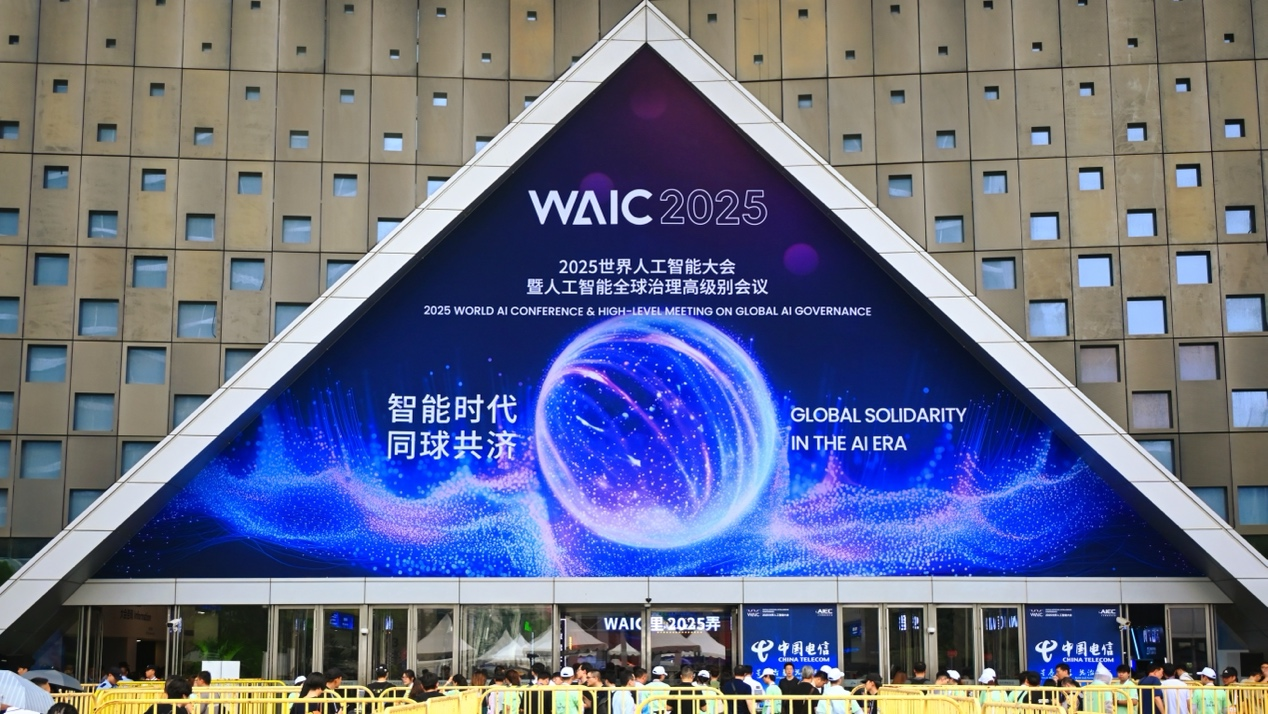
AI Empowering Thousands of Industries: Frontline Observations | Edge AI Intelligence Trends Seen from the World Artificial Intelligence Conference
The 2026 World Artificial Intelligence Conference and High-Level Conference on Global Governance of Artificial Intelligence (WAIC) concluded in Shanghai on July 20. Although the four-day exhibition was short, a clear signal was sent at this annual industry event—on-device AI intelligence is moving from concept to reality.
From July 17 to 20, the 2026 World Artificial Intelligence Conference and High-Level Conference on Global Governance of Artificial Intelligence was held in Shanghai. Photo by Xinhua News Agency reporter Chen Haoming.
Over the past few days, the World Expo Exhibition and Convention Center, the West Bund International Convention and Exhibition Center, and the Zhangjiang Science Convention Hall on both sides of the Huangpu River have been crowded with people, with various intelligent equipment making a concentrated debut. Unlike previous years, which focused more on conceptual demonstrations and technical showcases, this year's booths have seen visible, hands-on, and implementable on-device applications become the mainstream. AI is extending from the cloud to diverse terminals such as production lines, desktops, and wearable devices, and its role is accelerating from "answering questions" to "executing tasks."
Industrial End: Humanoid Robots Move from the Exhibition Floor to the Production Line
In the Embodied Intelligence Pavilion at the World Expo Exhibition and Convention Center, JAKA Robotics' booth was surrounded by a dense crowd of visitors. In the center of the hall, the JAKA K1-25 heavy-duty dual-arm humanoid robot was steadily lifting 50-kilogram dumbbells, demonstrating its load capacity of 25 kilograms per arm and a rated dual-arm load of 50 kilograms, along with a repeatability accuracy of plus or minus 0.05 millimeters. Nearby, "Pai Zai," standing 1.22 meters tall and weighing 42 kilograms, interacted with the audience through VR equipment, showcasing smooth movements in confined spaces relying on its self-developed APEX joint modules.
JAKA K1-25 heavy-duty dual-arm humanoid robot.
Unlike previous years when robots performed dances and somersaults on the exhibition floor, this year exhibitors are more inclined to have robots demonstrate their operational capabilities on simulated production lines. After two years of conceptual hype, the humanoid robot track has begun to differentiate. The evaluation criteria are no longer athletic ability or degrees of freedom, but whether they can create value in real production environments.
The development path of JAKA Robotics is quite clear—facing the production line and solving practical problems. Its wheeled humanoid robot collaborative assembly system, jointly developed with SAIC Huayu, attracted many professional visitors. This solution, selected for the central exhibition area of the conference, has achieved fully unmanned operations in a real mass production line, including the transfer of motor housings and the precision locking of 0.5-millimeter micro screws, with each screw taking only 10 seconds to lock. This is not just a product display, but a production line that has already been proven and is replicable.
"This year, the industry's focus has shifted from comparing technical parameters to the ability to implement in real scenarios," said Li Mingyang, founder and chairman of JAKA Robotics. The R&D team is based on the front line of factories, and all models and physical products must undergo in-depth verification in workshops. Relying on more than ten years of application experience in collaborative robots in fields such as automotive, 3C electronics, and semiconductors, JAKA is transforming a large number of complex and highly flexible operational needs into multi-task, cross-scenario autonomous operations empowered by AI large models.
In Li Mingyang's view, the ultimate form of AI and robot integration is human-robot collaboration, "allowing robots to assist humans in completing basic labor, so that humans can devote more energy to spiritual creation."
Joint modules displayed by Xinqi Robotics.
As robots move towards production lines, the upstream core component sector is also making simultaneous efforts. Xinqi Robotics has taken a different approach, making joint modules, ball screws, and ceramic balls the protagonists of its booth—these are key components that directly affect the motion accuracy and reliability of robots. Founded in August 2025, this company, supported by Lixing's many years of experience in precision bearing rolling element manufacturing, seeks to extend its material and process accumulation to the core transmission systems of robots. Shi Bo, founder of Shanghai Xinqi Robotics, explained: "Lixing has been making 'balls' for over thirty years. Now we are putting these 'balls' into the joints of robots." Currently, its self-developed silicon nitride ceramic balls have been put into application testing by leading robot enterprises, which can not only reduce the noise of dexterous hand prototypes to 68 decibels, but also the reverse planetary roller screws and joint modules for dexterous hands, wrists, and limb joints are being jointly developed, with core components planned to enter mass production by the end of this year.
Consumer End: AI Agents Shift from "Answering Questions" to "Executing Tasks"
As industrial robots start to do real "work," consumer AI applications are undergoing a similar transformation. They no longer just provide information but directly deliver results.
Youdao AI Earbuds OpenPods made their debut at WAIC.
"Large models solve 'how to think,' while Agents solve 'how to do,'" introduced Liu Renlei, senior vice president of NetEase Youdao. With Youdao's desktop-level Agent product LobsterAI, users only need to issue commands to automatically schedule tools such as files and browsers to complete the entire process from information search, report writing to document generation. The AI earbuds OpenPods, making their first appearance, integrate simultaneous interpretation, meeting minutes, and to-do extraction, supporting real-time mutual translation in over ten languages. "We are not just piling up hardware parameters, but redefining what these earbuds can help people do with an Agent mindset," said Liu Renlei.
Another consumer track is emotional companionship. Shanghai Kuchao Technology released the world's first AI emotional health smart ring. Through high-precision biosensors and self-developed algorithms, it converts physical signs such as heart rate into a visual "emotional weather" interface, generating personalized emotional trajectories and stress change curves. Shu Changjun, the founder of the company, believes that the next stage of smart wearables should not stay at physical indicator collection, but should extend to the perception, analysis, and companionship of emotional states, making hardware a "shadow companion that understands emotions and understands you better."
Computing Power End: Domestic Computing Power Foundation Accelerates into Shape
At this year's WAIC, the most significant change in the computing power track is that "SuperPods" have moved from concept to real machines. Huawei's Ascend 950 SuperPod (Atlas 950 SuperPod) made its public debut in the form of a real machine with 16 computing cabinets and 1,024 Ascend cards; the fully domestic 100,000-card AI supercluster—Sugon "Sugon 8000"—had its global premiere; and Alibaba exhibited the "Zhenwu M890 Panjiu AL128 SuperPod"... On the exhibition floor, the "sense of scale" of computing power has become concrete and tangible.
As SuperPods are built larger and larger and more and more computing cards are stacked, what is tested is the networking and scheduling of computing clusters. Jiliu Technology is targeting exactly this link. The company not only joined SenseTime's "Galaxy Project" as an ecological partner to co-build five 10,000-card domestic intelligent computing clusters, but its "AI-Native Unified Communication System and Ultra-Large-Scale Cluster Deployment Solution" also won the conference's SAIL Star Award.
"In the past two years, the computing power industry has been highly dependent on government subsidies and scientific research projects. This year, the domestic AI industry chain has achieved a closed loop of marketization and commercialization—the entire set of domestic software and hardware systems can independently face the market for commercial use," said Hu Xiaohe, founder and CEO of Jiliu Technology. He believes that the domestic AI entire industry chain has now crossed the critical point of commercialization. The significance of this transformation lies not only in the formation of the industry's own "blood-making capacity," but also in providing an independent underlying soil for upper-level application innovation.
As of April 2026, the number of GPU cards in AI clusters supported by Jiliu Technology has exceeded 90,000, with online operation and maintenance computing power scale exceeding 34,000 PFLOPS, cumulatively empowering four 10,000-card clusters. Consulting firm data shows that in terms of 2025 revenue, Jiliu Technology ranks first among China's independent AI computing cluster providers, with a market share of about 10%.
Rack-mounted server jointly launched by Lenovo and Lanxin Computing.
Independent breakthroughs in the computing power end are also reflected at the chip level. Lenovo and Lanxin Computing jointly launched the world's first AI server based on the RISC-V open-source architecture, equipped with a self-developed LX500 processor, integrating 75 TOPS AI computing power on-chip, capable of simultaneously supporting general computing and large model inference without the need for external acceleration cards. From the independent path of instruction sets for server CPUs to the networking and scheduling capabilities of 10,000-card clusters, domestic computing power is leaping from "usable" to "user-friendly," building an increasingly solid underlying foundation for on-device AI intelligence.
Breakthroughs in the computing power end go beyond commercial closed loops. Hu Xiaohe frankly stated that for artificial intelligence to truly achieve the development goals of empowering thousands of industries and being people-oriented, efforts must be made simultaneously on two levels: consolidating the foundation of independent and controllable at the bottom level, and doing a good job in safety governance constraints at the upper level. "In the next ten to twenty years, artificial intelligence will comprehensively drive technological change and social life innovation. Our long-term career is to connect the entire chain from underlying computing power to upper-level models and industry applications. This is not a matter of two or three years, but a long-term track of ten or twenty years."