
What organisers do after the show closes
When an exhibition ends, organisers usually publish a post-show report. The trouble is that a typical report runs to dozens of pages, packed with buyer origins, buyer numbers, exhibitor composition and transaction results.
Few people read a comprehensive post-show report from beginning to end.
Some organisers take a different route. After the show closes, they write thank-you letters to different groups of stakeholders. Unlike the long report, a short letter gets read properly. The reason is not length. It is function.
In fact, the thank-you letter is the most underrated form of writing in the exhibition industry.
On 28 October, the China Agricultural Machinery Distribution Association, the China Agricultural Mechanization Association and the China Agricultural Machinery Industry Association jointly released an open letter of thanks from the organisers of the China International Agricultural Machinery Exhibition to the entire industry and to society at large. It was framed as a public letter rather than a targeted note of gratitude, and the emphasis sits in the opening phrase: to the entire industry and to society at large.
Most thank-you letters from organisers are addressed to exhibitors and visitors, meaning one industry and a set of professional groups. This one put society at large on the list.
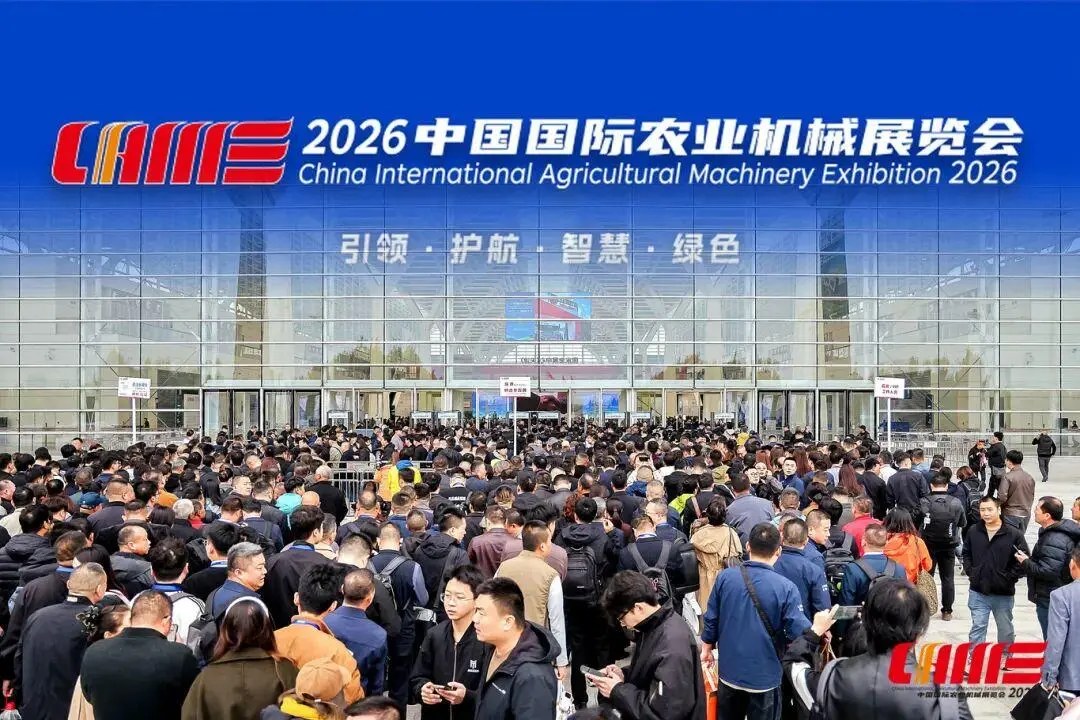
For the agricultural machinery sector, nearly 300,000 square metres and 3,168 exhibitors make this an annual gathering of the whole supply chain, close in nature to an industry Olympics. For the city of Tianjin, 200,000 visits and more than 100,000 out-of-town guests in three days put transport, security, fire safety, health services and hospitality under full strain.
This was no longer an industry event. It was a city-wide occasion held under the name of agricultural machinery, and the most direct illustration of how culture, commerce, tourism, sport and exhibitions can converge.
Once an exhibition reaches this scale, its boundary is no longer the red line around the venue but the carrying capacity of the city. That the organisers chose to thank society at large reflects a level of self-awareness only mature organisers develop.
300,000 square metres, all indoors, and 3,168 exhibitors leaving at once
Everyone says an exhibition is a systems engineering exercise. The hardest technical fact about this edition was the combination of 300,000 square metres and fully indoor space.
That means fire load, structural safety, ventilation, logistics flow, and the sequencing of build-up and tear-down all had to mesh precisely inside an enclosed environment. With 3,168 exhibitors and custom-built stands accounting for 52 per cent, every custom stand was an independent steel structure. A single error in move-in sequence would ripple down the aisles and turn into congestion.
The letter contains one sentence that is easy to read past: every company held on until the final moment of normal closing on 28 October, and then began dismantling in an orderly way under the organisers' coordinated arrangements.
More than three thousand exhibitors dismantling at the same time is the highest-risk window of any large exhibition, with vehicles flooding in, aisles clogging within minutes, and demolition work overlapping with people movement.
Getting 3,168 exhibitors to hold their positions at closing time and then leave in a coordinated order requires four things to hold simultaneously: a tear-down timetable, batched vehicle dispatch, one-way aisle control and an on-site command system.
It is like a major sporting event. Getting tens of thousands of people to the venue is not the problem. Getting them all to leave at the same time is the test. At this scale, the order at closing is the real exam paper for professionalism. That the letter singled out this detail shows the organic coordination among organiser, city and venue.
First move to Tianjin: a verifiable list of posts
The line about the exhibition moving to Tianjin for the first time, and the city embracing this gathering of steel with enormous goodwill, describes another side of the same story.
The word first is the most easily underestimated piece of information in the letter, and it is also the organisers' most direct acknowledgement of the host city and venue.
From an organiser's point of view, changing city makes every problem a new problem: which road will jam, which entrance peaks at what hour, how fire access connects to the surrounding road network, how hotel capacity is allocated, how staff and volunteers are trained, how emergency response is commanded.
Had the show stayed in the same venue year after year, much of this would be easier, solved by muscle memory. Moving to a new city and a new venue means no inherited experience, and only a few days to build everything from zero.
That is why the list of named thanks in the letter reads more like a map of urban joint operations. The Tianjin Municipal Agriculture Commission, the Commerce Bureau, the Public Security Bureau, the Jinnan District government, the venue and other relevant units held their posts around the clock across security, transport, fire safety, health and hospitality. Service providers covering venue services, logistics, registration, security staffing, volunteers, hotel reception, fleet dispatch, atmosphere and stand construction delivered support in every cordon instruction, every enquiry answered, every handover coordinated and every emergency response.
This passage turns urban hosting capability from an abstract concept into a verifiable list of posts. Whether a major exhibition lands successfully ultimately depends not on how complete the organiser's plan is, but on whether the city's relevant departments can organise themselves into a single machine in the few days before and after the show.
Conversely, the fact that the organisers dared to name these units so specifically suggests the coordination mechanism genuinely worked.
The scorecard: from volume to quality
This is the most objective part of the letter, with almost no subjective framing.
Exhibitors reached 3,168, up about 27 per cent. Exhibition space approached 300,000 square metres, fully indoors for the first time. Custom-built stands rose to 52 per cent of the total, and custom-built stands among parts and components exhibitors grew about 115 per cent. Visitors reached 200,000 visits, with more than 60,000 on opening day. The international agricultural machinery trade matching session drew more than 700 buyers from over 30 countries and regions for one-to-one meetings.
The figures support a shift from volume to quality.
A 52 per cent custom-build share means more than half the stands were not simple assemblies of standard booths, but companies willing to invest heavily in presentation. Willingness to exhibit is a direct indicator of exhibition quality.
Growth of 115 per cent in custom-built stands among parts and components exhibitors shows competition moving down from complete machines to the supporting segment. The supply chain is maturing, and the exhibition's ecosystem is tightening.
Beyond that, one-to-one meetings involving more than 700 buyers from over 30 countries show that internationalisation is becoming the exhibition's moat. This is also the shared opportunity and challenge facing China's best-known exhibitions.
The real scorecard for an exhibition is not how much floor space it added, but whether the exhibitor mix contains more people willing to invest.
Handing over the credit, writing down the commitment
Larger in scale, higher in quality, wider in influence, stronger in transactions: this is not the organisers' self-assessment, but a conclusion written by every one of you with your footsteps, your sweat and your trust.
In one sentence, the credit was handed over.
In public relations terms this is a precise transfer. The organisers do not claim success themselves. Instead, exhibitors, visitors, service providers and residents become co-authors of that success. Facts do the talking, and everyone is brought into the frame.
Every suggestion, every inconvenience and every expectation received during this edition will be reviewed item by item, carefully summarised, and answered actively in response to industry needs.
This is not a courtesy line. It commits publicly to a closed loop running from collecting opinions to a list of problems to corrective measures, effectively handing the acceptance criteria for the next edition to the industry in advance.
What matters in a thank-you letter is not how many kind things it says, but whether it dares to put its improvement commitments in plain sight.
Three days after the show, the lights in the halls dim one by one and the city returns to normal. Outsiders see the alternation of bustle and calm. Beneath the calm, the organisers have only just caught their breath.
The letter says closing is not farewell, and that the next edition will be held at a higher level, with more distinctive features and greater practical results. That is the next exam the organisers have set themselves.
For the exhibition industry, a well-written thank-you letter is in effect a public act of self-discipline.
This letter from the 2026 China International Agricultural Machinery Exhibition does three things at once. It is the press release marking a successful close, putting a full stop at the end of the show. It is the scorecard, setting out the result through 3,168 exhibitors, nearly 300,000 square metres, 200,000 visits and more than 700 buyers from over 30 countries. And it is genuine gratitude. No exhibition is ever easy, and people travelled to one city from around the world. By naming thanks down to every cordon instruction, every enquiry answered, every handover coordinated and every emergency response, the letter makes clear that success is built piece by piece, and depends on every unit and every person involved.
That is probably why a thank-you letter is worth reading more than a post-show report.