
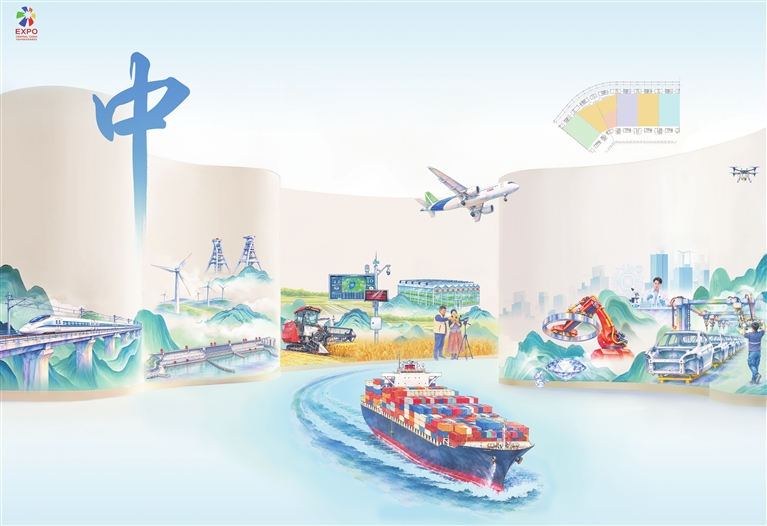
On November 21, the 14th Expo Central China opened at the Zhengzhou International Convention Center, running through November 23. This marks the third time this national-level economic and trade event has been hosted in Henan, and it also serves as a collective debut for the six central Chinese provinces in the inaugural year of the 15th Five-Year Plan. Themed "Building Three Bases and One Hub to Accelerate the Rise of Central China," the expo restructures its exhibition logic and matchmaking mechanisms around the strategic positioning of the region as a grain production base, an energy and raw materials base, a modern equipment manufacturing and high-tech industry base, and a comprehensive transportation hub.
Compared with previous editions, the most visible change this year lies in the exhibition layout. The 30,000-square-meter exhibition space is divided into two main sections: the Comprehensive Exhibition Area and the Integrated Domestic and Foreign Trade Exhibition Area. The Comprehensive Exhibition Area comprises five zones: the Central Six Provinces Zone, Sister Provinces Zone, International Cooperation Zone, Central Roadshow Area, and Comprehensive Service Zone, showcasing the industrial achievements and international cooperation resources of the six provinces. The Integrated Domestic and Foreign Trade Exhibition Area unfolds the entire industrial chain of "Made in Henan," featuring seven sectors: advanced manufacturing, lab-grown diamonds, ceramics, hair products, mugwort products, new retail, and cultural and digital trade. These are presented through a combination of data dashboards, thematic graphics, and miniature dioramas. The exhibition areas opened to the public after 11:00 a.m. on the 21st.
Breakthroughs at the institutional level are even more noteworthy. For the first time, the expo hosted the High-Level Symposium on Accelerating the Rise of Central China, where the six central provinces consulted on specific measures to implement the strategy for the rise of central China, translating consensus on strategic synergy, industrial collaboration, ecological co-governance, and transport connectivity into actionable items. Concurrently, the Ministry of Commerce held the "Invest in China: Choose Economic and Technological Development Zones" special event, targeting the 55 national-level economic and technological development zones in the six central provinces. Accounting for nearly a quarter of the national total, these zones serve as core vehicles for undertaking industrial relocation and driving institutional innovation.
Industrial matchmaking is the highlight of this year's expo, with 10 events tailored to the comparative advantages of the six provinces: Henan focuses on intelligent manufacturing, modern food, and superhard materials; Shanxi concentrates on metallic and inorganic non-metallic materials; Anhui bets on intelligent connected new energy vehicles and high-end equipment manufacturing; Jiangxi pushes forward in electronic information and intelligent manufacturing; Hubei lays out plans for optoelectronic information, biomedicine, high-end medical devices, and aerospace; and Hunan centers on advanced manufacturing and frontier materials. The six provinces will also jointly build the comprehensive exhibition area to promote inter-provincial procurement and resource sharing.
The roster of buyers and exhibitors reflects the international caliber of this expo. Executives from leading domestic and international enterprises, including Walmart, Siemens, Chery, CATL, and AutoNavi, have confirmed their attendance. Business associations such as the American Chamber of Commerce in China and the US-China Business Council are bringing delegations of their member companies to the event.
At the exhibit level, there are two key highlights. First is technological density: the ZQ Robotics T800 full-size humanoid robot, which recently helped set a Guinness World Record during the APEC meetings, will perform high-dynamic, complex movements on-site. ZQ Robotics stated that it is accelerating its investment layout in Henan, with plans to build an intelligent robot manufacturing base. Second is the consumer ecosystem: local Henan retail enterprises such as Pangdonglai, Huayu Baijia, and Xianfeng Life will appear in the new retail zone, illustrating the path of regional retail evolving from single-point breakthroughs to cluster growth.
Data shows that the six central provinces, with about one-tenth of the country's land area, are home to roughly a quarter of the population and generate about one-fifth of the national GDP. During the expo, host province Henan has organized three study tour routes focusing on intelligent manufacturing, culture and tourism, and commerce and trade, extending negotiations from the exhibition halls to actual industrial sites outside.
Over its 20-year history, the role of Expo Central China is evolving: from an early platform for investment promotion to a testing ground for regional coordination mechanisms. As the industrial portfolios of the six provinces are laid out on the same table, whether they can form a genuine cross-provincial division of labor in industrial chains is far more worth observing than the signed contract figures.