
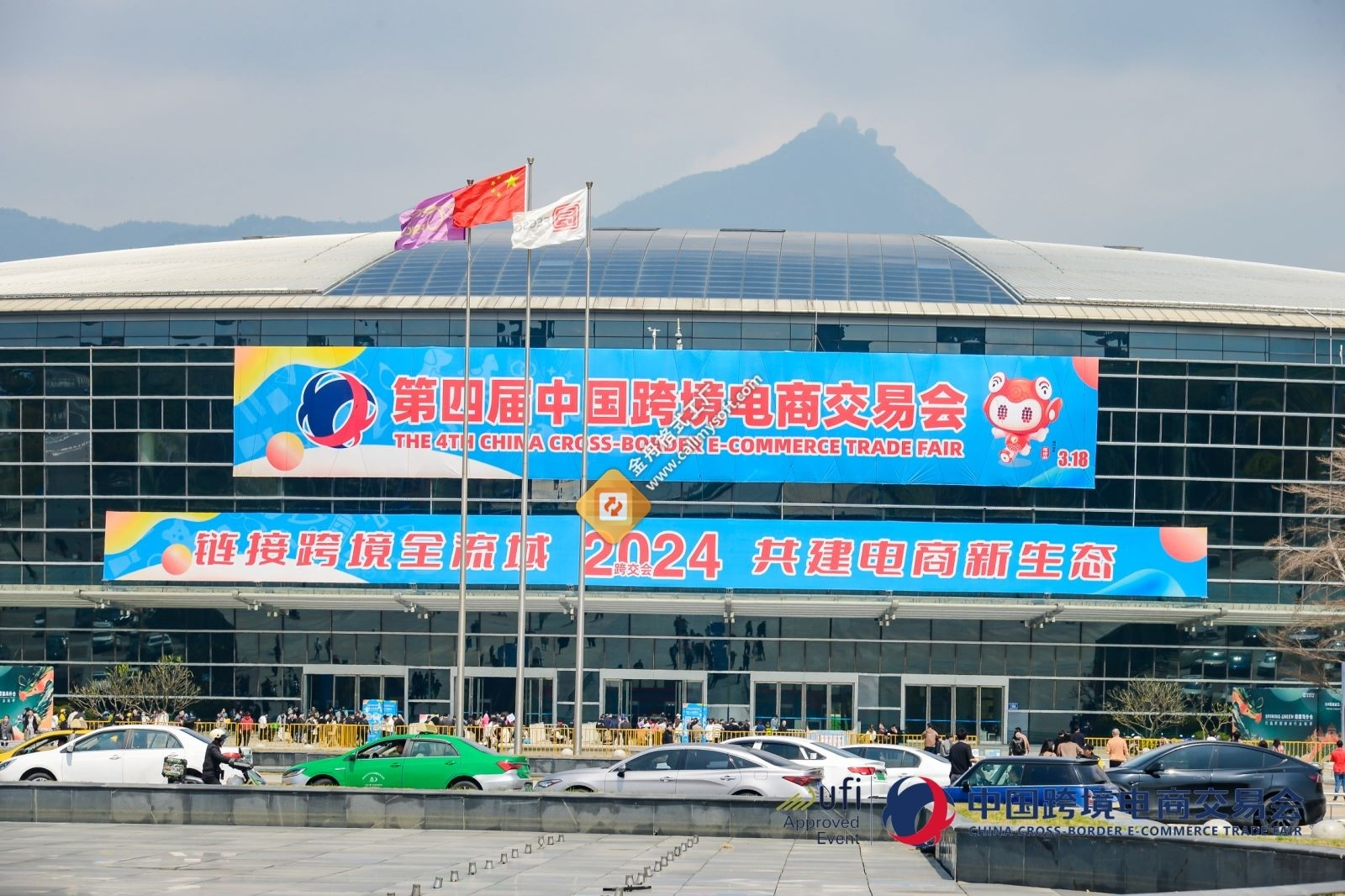
On March 18, the 5th China Cross-Border E-Commerce Trade Fair grandly opened in Fuzhou. Co-hosted by the Fujian Chamber of Commerce for Import and Export and the Foreign Trade Development Bureau of the Ministry of Commerce, the fair was organized by Fujian Huiyuan International Exhibition Co., Ltd., Fujian Huiyuan Culture Development Group Co., Ltd., and Fujian Midodo Network Technology Co., Ltd. Centered on the theme of "Upgrade" and closely focusing on "digitalization" and "new globalization," the event vividly demonstrated the industry's enduring pursuit of "innovation every year and highlights at every edition."
In terms of scale and exhibitor lineup, this year's fair attracted over 1,800 sourcing, supply chain, and service providers from 28 provinces, municipalities, autonomous regions, and special administrative regions across China, as well as from countries and regions including the United States, France, and Poland. With a total exhibition area of 60,000 square meters, the scale expanded significantly by 20% compared to the previous edition, showcasing the robust vitality and strong market demand of the cross-border e-commerce industry.
At the strategic level, the 2025 China Cross-Border E-Commerce Conference was launched concurrently. Themed "Upgrade to Global," the conference focused on the upgrading of the cross-border e-commerce industry ecosystem. It brought together elites from all walks of life, including founders of export manufacturing enterprises, CEOs of billion-level top sellers, executives from the world's top 20 platforms, mentors of bestselling overseas expansion methodologies, partners of billion-level funds in the capital circle, senior industry media professionals, influencers with tens of millions of followers, university scholars, and institutional experts. Together, they explored ways for Chinese enterprises to break through in going global, officially inaugurating a new strategic development pattern driven by the dual engines of "exhibition" and "conference." At the opening ceremony on the morning of March 18, distinguished guests including Jiang Yaoping, former Vice Minister of Commerce; Zhang Qi, new business architect; Huang Yuanpu, founder of Equal Ocean; and Deng Hai, CEO of Midodo Technology, jointly pressed the co-creation launch button, announcing the official release of the "2025 Blue Book on the Upgraded Development of China's Export Cross-Border E-Commerce." This marks the first blue book in the cross-border e-commerce industry co-created and released through the collective wisdom of multiple parties, holding significant guiding value for the sector.
In terms of conceptual upgrade, facing the rapid growth of cross-border e-commerce and the rapid iteration of digital technologies, this year's fair innovatively introduced the new concept of "data-driven exhibition," bringing a brand-new digital experience to visitors. In various exhibition zones such as home and daily necessities, maternity and baby products and toys, beauty and cosmetics, hardware and auto/motorcycle parts, shoes, clothing and bags, furniture and home decor, gifts and holiday supplies, and new consumer electronics, "Category Data Display Walls" were set up for the first time. These walls concentrated product comparison data from multiple sources like Amazon and TikTok, user pain points, and optimization suggestions, providing multi-dimensional data support for more precise product selection and R&D manufacturing for enterprises. Additionally, the fair significantly upgraded the "Cross-Border E-Commerce Trending and Hit Products Forecast Zone," innovatively established in the previous edition. It invited the renowned data service provider SellerSprite to publicly release the "2025 SellerSprite Trending and Hit Products Forecast Report" on-site, providing an authoritative guide for sellers' product selection. Meanwhile, the fair innovatively created a new buyer-seller matchmaking model featuring "digital identity + intelligent recommendation + real-time negotiation." Exhibitors' corporate information and product databases are synchronized in the cloud, enabling data tagging for exhibitors and supporting buyers to initiate precise matching requests online. The online mini-program scrolls to match supply and demand, breaking the limitations of time and space to achieve year-round uninterrupted matchmaking.
At the zone upgrade level, focusing on talent pain points and adhering to the "people-oriented" philosophy, the fair innovatively established the "Cross-Border E-Commerce Talent Matchmaking Zone." Around 200 enterprises organized recruitment on-site, inviting local universities to promote their graduates. An "AI Cloud Job Fair" sub-venue and an "AI Talent Recruitment and Introduction Center" were also set up to promote precise talent matching both online and offline. Following the great success of the previous edition, the fair once again invited overseas influencers for live-streaming sales, setting up a "Cross-Border Influencer Matchmaking Zone" to provide on-site one-on-one negotiations, meeting enterprises' needs for localized overseas promotion talents, and linking with the National Overseas Chinese Cross-Border E-Commerce Ecosystem Alliance and overseas Chinese associations in over 60 cities to promote international talent exchange. In addition, the "Cross-Border E-Commerce Clinic Zone" was expanded and upgraded. Besides continuing to invite experts from leading platforms such as Amazon Global Selling, eBay, and Shopee to provide on-site consultations, experts from over 10 niche blue-ocean platforms like Wejin International, Etsy, Kogan, and TradeMe were newly added. Sellers with outstanding cross-border AI capabilities also provided "consultation" services for the first time. The online appointment system was simultaneously optimized. This collaborative approach of "big hands holding small hands" to achieve common prosperity has been widely praised by government departments at all levels.
Regarding structural upgrade, the fair adheres to its positioning as a "cross-border e-commerce full-ecosystem chain exhibition with suppliers as the main exhibitors," with supplier enterprises once again accounting for 80%. Cross-border e-commerce exhibition delegations from Guangdong, Zhejiang, Jiangsu, Anhui, Guangxi, Beijing, Liaoning, Jilin, Xinjiang, Qinghai, Yinchuan in Ningxia, Langfang in Hebei, Yichun in Jiangxi, Pingxiang in Jiangxi, Ningde in Fujian, Longyan in Fujian, Quanzhou in Fujian, and Jiaozhou in Qingdao, Shandong, gathered to participate. Statistics show that nearly ten provincial-level commerce departments and over thirty prefecture-level commerce departments across the country organized delegations to exhibit and observe. The fair has explored and selected numerous popular platforms, including traditional giants like Amazon Global Selling, eBay, Walmart, and Wayfair, as well as regional powerhouses like Southeast Asia's Shopee and Lazada, South Korea's Coupang, Japan's Rakuten, Latin America's Mercado Libre, and Europe's Cdiscount, OZON, eMAG, Allegro, and JoomPro. Most notably, the "legion" of Chinese cross-border platforms, comprising Alibaba.com, Made-in-China.com, DHgate, SHEIN, TEMU, 1688, Taobao Global, and Xiaohongshu, drew the most attention, with several emerging domestic platforms making their debut. The service provider lineup is equally strong, including logistics service providers like Fandian International and Zongteng Group, payment service providers like Alibaba.com Pay, WorldFirst, and PingPong, training service provider Ule Overseas, software service provider SellerSprite, overseas marketing service provider Midodo Technology, and flexible supply chain service provider Hummingbird Customization. The area of custom-built booths at this fair accounts for nearly 50%, reaching a new high. Huiyuan Culture Group, a leading overseas exhibition enterprise, presented a panoramic view of nearly 200 cross-border e-commerce suitable exhibitions worldwide in a one-stop manner, providing front-line services to enterprises aiming to "buy global, sell global," and assisting domestic products in going global steadily.
In terms of supporting activities upgrade, on the morning of March 18, with the support of the United Nations Global South-South Development Center project and the China South-South Industrial Cooperation Center project of the United Nations Industrial Development Organization, the South-South Cooperation Exchange Conference on Promoting Cross-Border E-Commerce Development was successfully held. It leveraged the "small fulcrum" of cross-border e-commerce to promote South-South "macro-framework" cooperation, helping Chinese enterprises explore and cultivate emerging markets primarily composed of developing countries. In the afternoon, the Minjiang Digital Trade Corridor Innovation and Development Conference saw the official launch of both the "Minjiang Digital Trade Corridor" and the "Silk Road E-Commerce" Cross-Border Ecosystem Alliance. This marks a new starting point on the 10th anniversary of the construction of the Fuzhou New Area and the Fuzhou Pilot Free Trade Zone, where Fuzhou City, taking cross-border e-commerce as an entry point, relies on the Minjiang Digital Trade Corridor to advance cooperation with Silk Road partners to a higher level, and the experimental exploration of the "Digital Silk Road" enters a new stage. In addition to the more than 20 thematic sharing sessions held at the 2025 China Cross-Border E-Commerce Conference, 30 high-specification forums, conferences, and matchmaking events were also held in various conference rooms and the exhibition forum area. These covered hot topics such as the China Min Merchants Cross-Border Conference, new opportunities in TikTok's US and Southeast Asian markets, the 2025 Amazon Global Selling Cross-Border E-Commerce Development Trend Sharing, AI-empowered refined operations, the Southeast Asia Overseas Expansion Forum, the path to compliance in cross-border e-commerce, and the Global Opportunities Sharing Conference for Cross-Border E-Commerce. They were widely sought after on the first day, with venues packed to capacity.