
Headlines

TSMC Q2 Net Profit Hits 706.56 Billion TWD, Surging 77.4% Year-on-Year

TSMC Q2 Net Profit Hits 706.56 Billion TWD, Surging 77.4% Year-on-Year

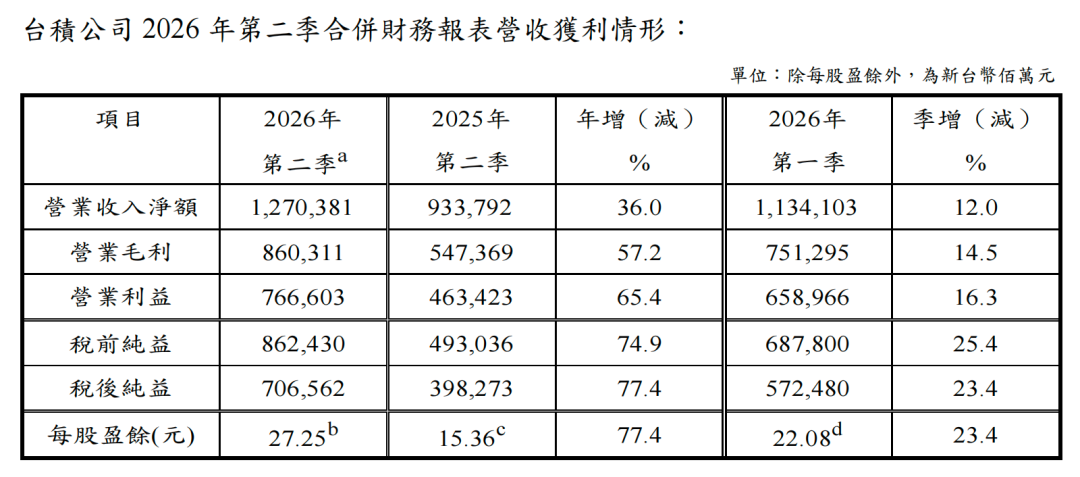
On the afternoon of July 16, TSMC released its Q2 2026 earnings report: quarterly revenue reached 1.27 trillion TWD (approximately $40.2 billion), up 36.0% year-on-year; net profit hit 706.56 billion TWD (approximately 148.943 billion yuan), surging 77.4% year-on-year and setting historical records for five consecutive quarters. TSMC simultaneously raised its full-year 2026 revenue growth forecast and capital expenditure budget, providing the latest evidence of sustained AI demand.

The improvement in profitability is even more striking. Gross margin reached 67.7%, up 9.1 percentage points year-on-year; operating margin was 60.3%, up 10.7 percentage points; net margin reached 55.6%. This means for every 100 yuan in revenue, TSMC converts over 55 yuan into net profit.

From a revenue structure perspective, advanced process nodes continue increasing in value: 7nm and below accounted for 77% of total wafer revenue, with 5nm at 33%, 3nm at 30%, 7nm at 11%, and the recently ramped 2nm process (mass production began last Q4) already contributing 3%.

By application platform, High Performance Computing (HPC) accounted for 66% of total revenue, up 20% sequentially — the clear growth engine; smartphones represented 22%, down 4% sequentially; IoT, automotive, and consumer electronics accounted for 5%, 4%, and 1% respectively. Geographically, North American customers contributed 78% of revenue.

TSMC Chairman and CEO C.C. Wei candidly acknowledged during the earnings call that he cannot quantify the market growth driven by AI, 'because this wave is getting stronger and stronger.' TSMC currently still faces capacity constraints, with advanced packaging capacity unable to meet demand, and the company is working to narrow the supply-demand gap.

Based on optimistic demand assessments, TSMC released a series of positive signals: full-year 2026 USD revenue growth guidance was raised from 'exceeding 30%' to 'slightly above 40%'; capital expenditure budget was increased from $52-56 billion to $60-64 billion, with 70-80% directed toward advanced process nodes.

Wei also confirmed an additional $100 billion investment in Arizona, USA, to build 2nm and below advanced fabs and advanced packaging facilities, bringing TSMC's total US investment to $265 billion. Additionally, the A14 process is expected to enter mass production in 2028, with A13 and A12 in 2029.

Analysts note that demand for TSMC's 3nm and 2nm process technologies for AI chips and its advanced packaging technology CoWoS remains strong. Citi Research has raised its TSMC target price from 2,875 TWD to 3,800 TWD.

Despite beating expectations across the board, TSMC's US ADR fell over 4% in pre-market trading on July 16, closing at $409.74, down 2.32%. Market analysts believe the impact of significantly raised capex forecasts outweighed the earnings beat. Over a longer timeframe, TSMC shares rose 37% in Q2, with year-to-date gains approaching 60%, and current market capitalization of approximately $2 trillion.

行业

相关文章

IFA 2026 Opens in Berlin, Shaping Six Cutting-Edge Technology Trends

IFA Berlin 2026 has officially opened in Germany. This premier global technology showcase spotlights health and hygiene upgrades in cleaning appliances, the surge in balcony solar PV systems, and the pragmatic evolution of humanoid robotics. Meanwhile, Dyson’s unveiling of its latest product lineup underscores the formidable prowess of China's smart manufacturing, while also highlighting the challenges posed by trade barriers to overseas expansion.

26th China International Fair for Investment and Trade Opens in Xiamen, Harnessing Global Resources to Foster Two-Way Investment

The 26th China International Fair for Investment and Trade opened in Xiamen, spanning an exhibition area of 200,000 square meters. Centered on three core investment sectors, the event marks the first time Finland and Saudi Arabia have been designated as the dual Guest Countries of Honor. The fair showcases cutting-edge technologies, surging foreign investment, and the global expansion achievements of Chinese enterprises, uniting efforts to advance global development.

21st China International Exhibition for Small and Medium Enterprises Opens in Guangzhou, Bringing Together Over 2,000 Global Enterprises to Share Opportunities

The 21st China International Exhibition for Small and Medium Enterprises was held in Guangzhou, spanning 85,000 square meters and hosting 2,000 exhibitors. Co-located with the APEC SME Ministers' Meeting, the event pioneered the "One Conference, One Exhibition" synergy model. With full participation from all APEC member economies, the exhibition showcased AI-driven innovation and a vibrant convergence of diverse cultures, delivering a substantial international impact.

102nd IFA Berlin Opens in Germany as Nearly 1,000 Chinese Companies Converge to Showcase Technological Prowess

The 102nd edition of IFA Berlin has opened its doors in the German capital, with an expected attendance of 220,000 visitors. Chinese participation has reached an all-time high, with a record-breaking 932 companies exhibiting at the show. Industry leaders such as Xiaomi and TCL are showcasing robust innovation in AI, robotics, and smart home appliances, accelerating their expansion across the European market.

2026 Yeosu World Islands Expo Opens in South Korea, Drawing Local Governments and International Organizations from 30 Countries

The 2026 Yeosu World Islands Expo has officially opened in Yeosu, South Korea, kicking off a 61-day run. As the world's premier island-themed exposition, the event brings together 30 countries and international organizations across eight major pavilions. Key highlights feature a seamless blend of futuristic technology, digital art, and half-price island excursion packages, delivering a truly immersive, multi-dimensional experience.

IFA 2026 Opens in Germany: 1,000 Chinese Companies Converge to Showcase AI Ecosystem

IFA Berlin 2026 is currently underway in Berlin, Germany, bringing together over 1,900 brands and drawing an expected attendance of more than 220,000 visitors. The standout highlight of the exhibition is the participation of nearly 1,000 Chinese companies, which are collectively showcasing humanoid robots, smart home appliances, and full-ecosystem products, underscoring China's leadership in comprehensive technology ecosystems.