
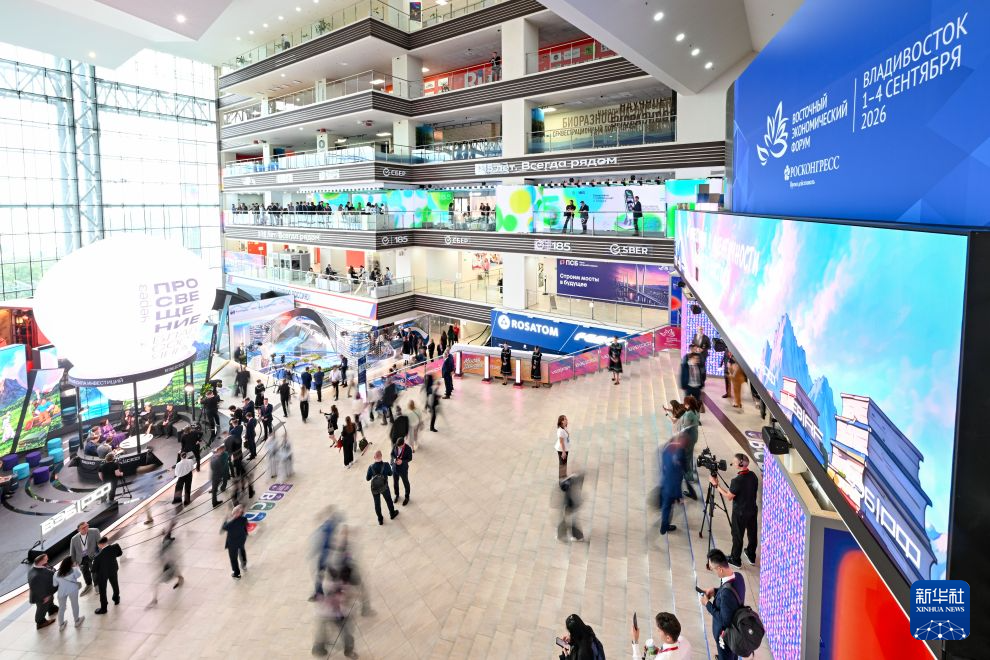
On September 1, the 11th Eastern Economic Forum (EEF) officially kicked off at the Far Eastern Federal University campus in Vladivostok, Russia. Spanning four days, the event will run through September 4. As Russia's premier multilateral economic cooperation platform in the Asia-Pacific region, this year's forum has drawn over 5,000 delegates from 80 countries and regions. Numerous nations have dispatched high-level delegations to deliberate on the development of the Russian Far East and broader Asia-Pacific regional cooperation.
Initiated by Russian President Vladimir Putin, the EEF has evolved into a vital mechanism for driving the socio-economic development of the Russian Far East and deepening economic, trade, and investment cooperation across the Asia-Pacific since its inception in 2015. Centered on the theme "The Far East: A Hub Connecting Eurasia," this year's forum features in-depth discussions on critical areas including global supply chain restructuring, Asia-Pacific regional integration, the development of Advanced Special Economic Zones in the Far East, technological innovation, and the digital economy.
Across the Far Eastern Federal University campus, forum activities are proceeding seamlessly. The plenary session, alongside a dense schedule of parallel sessions and business dialogues, is in full swing. Senior government officials, multinational executives, representatives from international organizations, and distinguished scholars from Russia, China, India, ASEAN member states, and other Asia-Pacific regions have convened to exchange insights on enhancing regional connectivity, optimizing the business environment, and facilitating trade and investment under the current global landscape.
During the forum, the Russian Ministry for the Development of the Russian Far East and the Arctic unveiled the latest investment promotion data and policy frameworks for the region. In recent years, the Russian government has steadily increased infrastructure investment in the Far East, rolling out a suite of tax incentives and administrative streamlining measures—such as the Advanced Special Economic Zones and the Free Port regime—which have attracted substantial domestic and foreign capital. Delegates widely recognize that the Far East, endowed with abundant natural resources, immense market potential, and a unique geographic advantage, is steadily increasing its share within the Asia-Pacific economic sphere.
As one of the Russian Far East's most vital economic and trade partners, China has been a focal point at this year's forum. Sino-Russian cooperative projects in energy, agriculture, logistics, and high-tech sectors have emerged as hot topics. Representatives from both sides have reached broad consensus on deepening cross-border industrial chain cooperation and advancing the alignment of major infrastructure projects.
Beyond high-level political and business dialogues, the forum also features a massive commercial exhibition showcasing the investment potential, flagship projects, and specialty products of the Russian Far East. Numerous international exhibitors engaged in face-to-face negotiations with regional governors to explore partnership opportunities in mineral resource development, port logistics, and cross-border e-commerce.
The convening of the 11th Eastern Economic Forum not only injects fresh vitality into the development of the Russian Far East but also provides a valuable opportunity for Asia-Pacific nations to strengthen pragmatic cooperation and achieve mutual benefit amid a complex and evolving international landscape. As the forum's agenda progresses, the signing of various cooperation agreements and the materialization of key projects will undoubtedly inject robust new momentum into regional economic prosperity and development.