
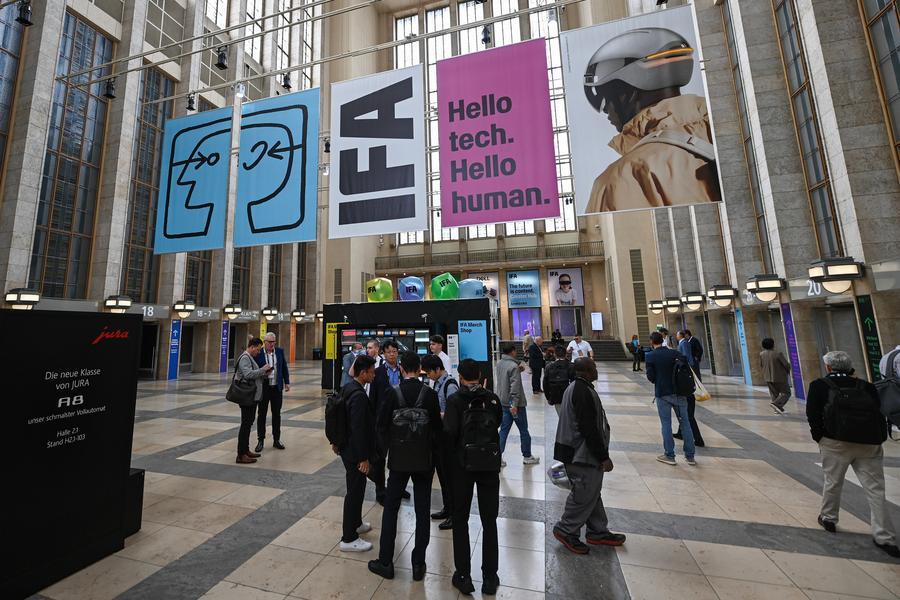
IFA Berlin 2026 is currently in full swing in Berlin, Germany. As one of the world's largest trade fairs for consumer electronics and home appliances, this year's IFA is themed "The Future is Now," bringing together over 1,900 global brands and expecting to attract more than 220,000 visitors. Leif Lindner, head of the exhibition organizer, noted that AI is no longer confined to content generation and complex task processing; it is increasingly making its way into the physical world. Centered around this cutting-edge theme, Chinese companies at this year's IFA are capturing the attention of overseas consumers with higher visibility and stronger product prowess, showcasing the possibilities of AI-powered lifestyles and drawing significant attention from the industry and media.
This year's IFA kicked off on September 4 and runs through the 8th. On the 5th local time, reporters at the North Gate of the Messe Berlin noted the prominent promotional posters for Chinese enterprises such as Haier, Midea, and Xiaomi, with Chinese exhibitors occupying a substantial proportion across multiple halls. According to a report by rbb24, the Berlin-Brandenburg Broadcasting Corporation, around 1,000 Chinese companies are showcasing at IFA this year, a significant increase from over 700 last year, truly marking that "China has taken center stage." By comparison, there are 201 German exhibitors and only 5 from Japan. Commenting on this, Leif Lindner remarked that over the past many years, Chinese companies have deliberately focused on making their innovation more sustainable. "They have kept pace with the trends, and that is why they are now ahead of the curve." Spanish entrepreneur Jose also remarked in an interview, "Walking through the Chinese brand pavilions and then entering halls dominated by companies from other countries feels like stepping back in time."
When it comes to the most popular halls, Hall 25, which gathers Chinese humanoid robot companies, is undoubtedly one of them. Robots from Chinese company Unitree danced gracefully on the booth, while performances such as robot soccer shooting and boxing matches by brands like BOOSTER took turns captivating the crowds. In the home service robot exhibition area, Chinese brands almost entirely dominate the space. They have launched diversified, segmented product features tailored to the diverse lifestyle scenarios of global users. At this year's fair, Ecovacs debuted a multi-category robot product lineup including DEEBOT, WINBOT, and GOAT, covering home scenarios such as floors, windows, courtyards, and swimming pools. To test the effectiveness of the robot vacuums, some German visitors poured ketchup on the floor. As the robot swept the ketchup away spotlessly, a female visitor on-site exclaimed, "I didn't expect it to work this well."
The boom in the home cleaning robot market further corroborates this trend. The latest report released by the International Data Corporation (IDC) shows that in 2025, global shipments of home cleaning robots reached 32.72 million units, a year-on-year increase of 20.1%. Leading robot vacuum companies continue to expand product boundaries, with emerging niche segments such as robotic lawnmowers and pool cleaning robots constantly emerging. A representative from Roborock stated in an interview that the underwater cleaning segment is at a critical window for generational leaps—from wired to wireless, and from random bumping to intelligent planning. Consumer demand for underwater cleaning devices is undergoing a comprehensive transition from simply "being able to clean" to "intelligent cleaning" with autonomous path planning, environmental perception, and smart connectivity. Citing the RockAqua P1, Roborock's first pool cleaning robot unveiled at IFA, the representative explained that the product features adaptive path planning capabilities. "Whether it is a diamond-shaped, kidney-shaped, or other irregularly shaped pool, it can intelligently match the corresponding movement route to achieve maximum coverage."
While targeting niche segments, Chinese companies' ability to build "product ecosystems" has also attracted widespread attention. At this year's IFA, Chinese tech giant Xiaomi made its debut. Lu Weibing, President of Xiaomi Group, stated in an interview, "Xiaomi's participation here represents more than just a Chinese company coming to IFA; it represents China's technology, ecosystem, and business model." Centered around three core exhibition zones—"AI Tomorrow," "AI Today," and the "Human-Car-Home product matrix"—Xiaomi is showcasing over 380 products, marking its largest-ever overseas display of its "Human-Car-Home ecosystem." rbb24 analyzed that Xiaomi can be seen as a representative of a development trend now observable almost everywhere at IFA: Chinese companies are no longer just showcasing single devices or affordable alternatives to well-known brands, but rather complete product ecosystems—ranging from smartphones and home appliances to cars and robots. Nikkei Asia recently cited industry insiders' analysis, reporting that over the past decade, Chinese companies have consolidated their position in Europe by responding to the demand for energy-efficient products and smart home technologies. From breakthroughs in single products to leadership in full ecosystems, Chinese tech companies are playing an increasingly central role on the global consumer electronics stage.