
On October 14, the Ministry of Foreign Affairs held a regular press conference. A reporter asked: The 140th Canton Fair is about to open, and the ninth China International Import Expo (CIIE) will begin on November 5. China has also recently held the China International Fair for Trade in Services, the China-ASEAN Expo and the Global Digital Trade Expo. Some media have commented that China's consecutive international exhibitions have drawn active participation from companies around the world and become an important driver of global economic and trade development. What is the spokesperson's comment?
Foreign Ministry spokesperson Mao Ning replied: “This series of exhibitions are all important windows for China to connect with the world, drive development and benefit people's lives. This year marks the 70th anniversary of the Canton Fair, with 32,000 enterprises taking part, including more than 11,000 high-quality firms such as specialized and sophisticated 'little giant' enterprises and single-champion manufacturers. This year the CIIE will continue to offer free booths to the least developed countries and upgrade its Asian and African product zones to help African countries that have diplomatic ties with China seize the benefits of zero-tariff treatment. Behind the strong appeal of these exhibitions is China's resolve and effort to advance high-level opening-up and share development opportunities with the world.”
On October 14, President Xi Jinping sent a congratulatory letter to the 140th China Import and Export Fair (Canton Fair). Xi Jinping noted: Over the past 70 years since its founding, the Canton Fair has played an important role in promoting trade between China and the rest of the world and has become an effective platform for China to expand high-level opening-up and advance the building of an open world economy. Under the new circumstances, China stands ready to work with all countries to uphold the multilateral trading system, keep global industrial and supply chains stable and smooth, expand space for mutually beneficial international economic and trade cooperation, and advance inclusive economic globalization that benefits all, so as to continuously inject new impetus into world development and prosperity.
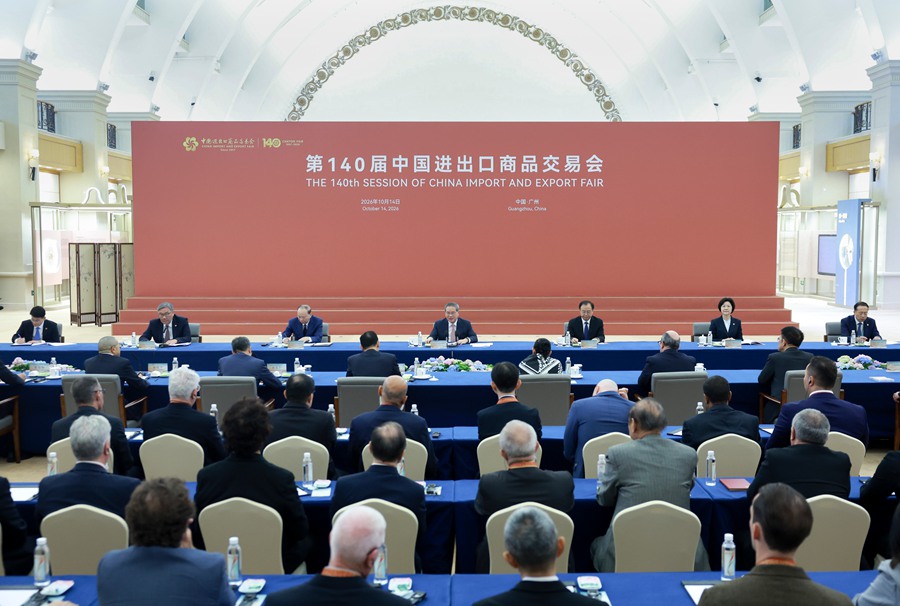
On October 14, Premier Li Qiang attended the opening ceremony of the 140th Canton Fair in Guangzhou and delivered a keynote speech. Li Qiang noted: This year marks the 70th anniversary of the Canton Fair. President Xi Jinping has sent a special congratulatory letter, fully affirming the Fair's achievements and reaffirming China's firm resolve to expand high-level opening-up. Through the window of the Canton Fair, the world sees the enormous vitality of the Chinese economy and society, witnesses the remarkable journey of the hard-working Chinese people, and feels the deepening bond between China and the world.
It is learned that more than 30,000 enterprises are exhibiting at this session, with about 340,000 overseas buyers attending for procurement. More than 700 representatives from all sectors of nearly 90 countries and regions attended the opening ceremony, and WTO Director-General Ngozi Okonjo-Iweala delivered a video address. After the ceremony, Li Qiang toured the enterprise pavilions of the Fair.
On September 24, Premier Li Qiang also attended and addressed the launching ceremony of the fifth Global Digital Trade Expo in Hangzhou. He noted that the Expo has become an important platform for promoting global digital economic cooperation, and that countries should promote the sound development of global trade in the digital era with openness, oppose bloc-based and exclusive arrangements, seek the broadest common ground, and build a fair and rational economic and trade order. China's artificial intelligence and other technologies follow an open-source and open approach, building a 'digital ladder' that all countries can climb.
On September 17, Ding Xuexiang, Member of the Standing Committee of the Political Bureau of the CPC Central Committee and Vice Premier of the State Council, attended and addressed the opening ceremony of the 23rd China-ASEAN Expo and the China-ASEAN Business and Investment Summit in Nanning. He noted that the China-ASEAN Free Trade Area is an important vehicle for building the two sides' community of shared future, and called for a comprehensive rise in regional opening-up, faster building of an open, inclusive and rules-based integrated regional market, broader and deeper cooperation, and joint efforts to safeguard the stability of regional and global industrial and supply chains.
According to the China Council for the Promotion of International Trade (CCPIT) Report on the Development of China's Exhibition Economy 2025, China held 4,095 economic and trade exhibitions above 2,000 square meters in 2025, with a total exhibition area of 159 million square meters, up 6.53 percent and 2.5 percent year on year respectively, both record highs. With 13.662 million square meters of indoor exhibition space, China accounted for 81.0 percent of the Asia-Pacific total, operating 323 venues, of which 224 exhibition halls were in actual operation.
In her video address at the opening ceremony, WTO Director-General Ngozi Okonjo-Iweala said: China's remarkable development has offered rare opportunities to the world. The Canton Fair is an important platform connecting China with the world. Against rising global uncertainty, she hoped all parties would jointly advance WTO reform and build an open, rules-based global trading system.
(Sources: Ministry of Foreign Affairs, Xinhua News Agency, State Council of China, China News Service, and CCPIT Report on the Development of China's Exhibition Economy 2025.)