
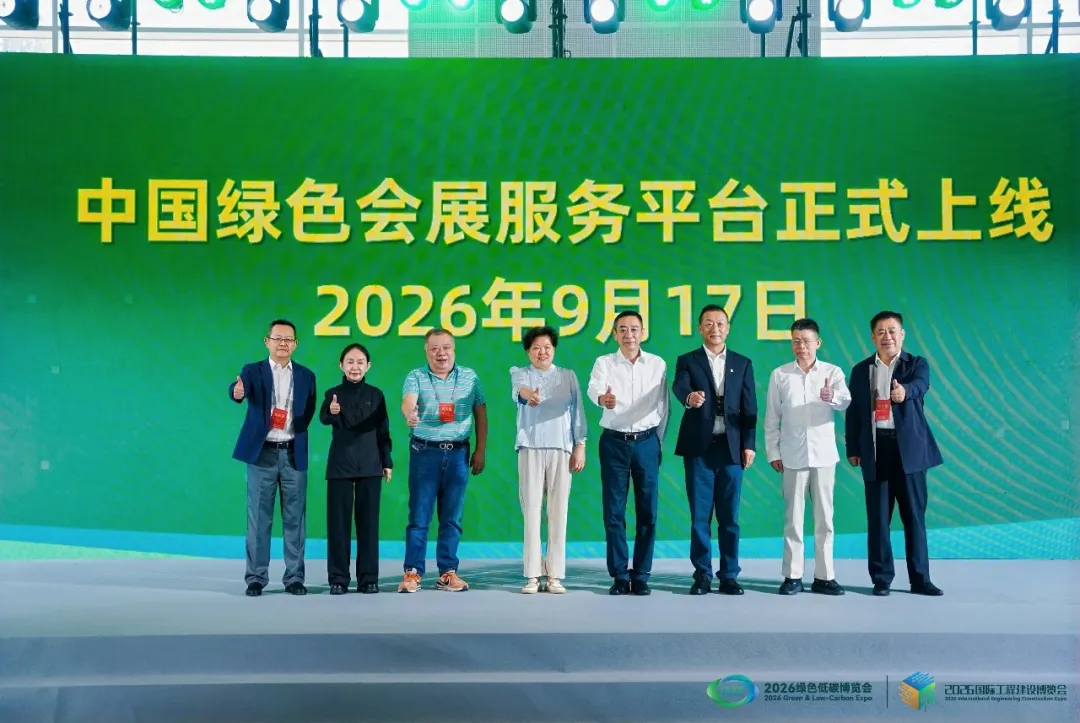
On September 17, the China Green Exhibition Service Platform, jointly developed by the International Exhibition Economy Committee (ICEEC) of the China Association for International Economic Cooperation and a number of industry institutions, was officially launched at an exchange meeting held at the National Exhibition and Convention Center (Tianjin). The platform aims to address the widespread challenge across the exhibition industry of "wanting to go green but not knowing how," providing exhibition organizers with a clear, convenient and actionable pathway toward green transformation. Its launch marks a new stage in which China's green exhibition sector moves toward digitalized and integrated services.
At the launch ceremony, Gao Yuanyuan, President of the China Association for International Economic Cooperation; Chen Yongqing, former Director-General of the Department of Soil Ecology at the Ministry of Ecology and Environment; Zhang Yijun, former Minister-Counselor of the Chinese Embassy in Kenya; Yu Jie, Vice Chair of the Agriculture and Rural Affairs Committee of the China Democratic League; Liu Xinguo, Deputy Director of the Tianjin Municipal Commerce Bureau; Zhu Yongyi, Chairman of the China Commodity Trading Market Council; Fan Peikang, Chairman of ICEEC and former President and Editor-in-Chief of China Trade News; and Gao Zijian, Vice President of the National Exhibition and Convention Center (Tianjin) Co., Ltd., jointly inaugurated the platform.
Positioned as a comprehensive public-interest service platform integrating "standards inquiry, tool support, resource matching and case sharing," the platform connects six core functions: policy access, standards study, carbon accounting tools, case references, a materials library and resource matching. It brings together policies, standards, technologies, cases and supply-demand resources that were previously scattered across different sources. Industry practitioners no longer need to gather information from multiple channels; on one platform they can study policies, measure carbon footprints, review benchmark cases and connect with upstream and downstream resources, supporting the routine green upgrading of the exhibition industry. The platform is accessible at https://cgce.iceec.org.cn .
The platform precisely targets three core pain points in promoting green exhibitions. First, difficulty in finding standards: the platform collects national and local green-exhibition standards and guidelines through a unified, easy-to-use search portal, helping organizers quickly understand compliance requirements and clarify "what counts as green." Second, the lack of tools and methods: the platform offers practical tools such as low-carbon material selection and a carbon emission calculator, along with technical guides on modular construction and reusable exhibit fittings, lowering the technical threshold for green transformation and answering the question of "how to do it." Third, poor resource matching: the platform integrates high-quality upstream and downstream resources across the industrial chain, including green venues, eco-friendly stand builders, low-carbon logistics providers and waste recycling organizations, building a green-exhibition ecosystem that resolves "who to work with" and enables efficient supply-demand matching.
Guests at the ceremony broadly agreed that green exhibitions are a systemic project requiring coordinated development across the entire industrial chain, and that the platform is a key step toward improving the industry ecosystem and lowering the threshold for enterprises' green transformation. By effectively connecting government, associations, organizers, service providers and exhibitors, the platform will foster a virtuous cycle of value co-creation, inject strong momentum into the nationwide popularization of green-exhibition concepts and practices, and accelerate the high-quality development of China's exhibition industry toward a green, low-carbon and circular direction.