
The 42nd Abu Dhabi International Petroleum Exhibition and Conference (ADIPEC 2026) opened on November 2 at the Abu Dhabi National Exhibition Centre and runs until November 5. With 2,260 exhibiting companies, 16 fully booked halls, 30 country pavilions and 239,000 expected participants from more than 170 countries, it is the largest edition in the event's history.
But the number that best explains what this edition has become is not any of those. It is an agreement signed on opening day.
Part One: No room left, so the opening ceremony moved
Demand for exhibition space far outstripped supply, and the organisers did something rarely seen: they moved the opening ceremony out of the Abu Dhabi National Exhibition Centre to the Abu Dhabi Energy Centre, freeing the space for more exhibition floor.
Christopher Hudson, President of dmg events, put it plainly: "The industry's commitment to ADIPEC is clear. We have a record-breaking 2,260 exhibiting companies, with the exhibition venue fully sold out and additional structures built to accommodate demand. We've also relocated the Opening Ceremony to create even more exhibition space."
He added: "ADIPEC is about more than scale. It reflects the importance the industry places on meeting face to face, particularly at a time when energy security, resilience and economic competitiveness are top priorities for governments and businesses worldwide."
This year's theme is "Unite Where Energy Security Takes Shape", focused on energy security and resilience, attracting investment, building infrastructure, and using artificial intelligence and digital technologies to improve operational efficiency, raise productivity and accelerate project delivery. More than 40 ministers and policymakers attended, with over 1,800 speakers across 380-plus sessions in 13 conference programmes.
The exhibition features four specialised zones: artificial intelligence, digitalisation, low carbon and chemicals, and maritime and logistics. The AI Zone, co-hosted by AIQ, is larger than in previous editions.
Part Two: AI moves from the show floor into the decision layer
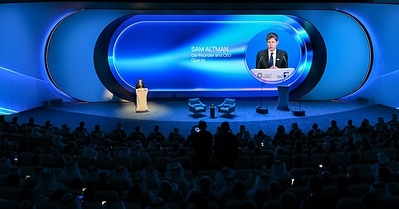
On November 2, ADNOC signed a multi-year partnership with OpenAI and G42, becoming the first energy company in the world to deploy OpenAI's Frontier platform. The agreement was signed in the presence of Sheikh Khaled bin Mohamed bin Zayed Al Nahyan, Crown Prince of Abu Dhabi, with OpenAI CEO Sam Altman in attendance.
What matters about the deal is not that AI is being used, but which layer of the business it is being used at.
Two applications land first. The first is field master planning: separate subsurface studies, surface facility studies and economic evaluations are merged into a single integrated decision. The system draws on decades of data across thousands of wells, multiple stacked reservoirs and hundreds of surface facilities, together with capital, cost and commercial conditions, to prepare and optimise full-field development plans in hours rather than months.
The real change is not only speed but scope: instead of optimising each reservoir or facility on its own, the whole field is solved at once.
The second application is rarer still. ADNOC becomes the first energy company in the world to value every barrel while it is still in the ground. The system connects the entire chain — production, processing, refining, logistics, sales and trading — linking decisions that today sit in different systems, on different data and against different priorities. Interconnected AI agents continuously forecast crude supply, demand, prices and margins, anticipate impacts before they occur, and weigh the commercial and operational consequences of every decision as one integrated process.
Sultan Ahmed Al Jaber, UAE Minister of Industry and Advanced Technology and ADNOC Managing Director and Group CEO, said at the opening: "The next frontier of AI is not simply doing things faster. It is making possible what was previously beyond reach."
He continued: "As the first energy company to deploy OpenAI Frontier, we are demonstrating how frontier AI can move beyond individual applications to reshape the performance of an entire industry. This is industrial AI at scale, pioneered here in Abu Dhabi, and it will help define the future of energy."
The capability did not appear from nowhere. AIQ, ADNOC's joint venture with G42, has been commercialising AI for oil and gas since 2019; ENERGYai is a 70-billion-parameter model trained on more than 50 years of ADNOC data. The group has more than 200 AI applications and 70 robotics use cases deployed or under development, and ChatGPT Enterprise has been rolled out to more than 40,000 employees with adoption above 97 per cent — the largest enterprise deployment in the Middle East and North Africa.
Sam Altman said in his opening conversation: "More capable AI can help us tackle some of the world's hardest problems — particularly around energy. By combining frontier AI, sovereign infrastructure and industry expertise, this first-of-its-kind partnership will help ADNOC move faster, operate more efficiently and make better decisions across the energy value chain."
Where the computing sits is worth noting: inference infrastructure is deployed inside the UAE on G42's sovereign AI infrastructure, and human experts retain oversight of consequential decisions.
Part Three: Four agreements in a single day
The ADNOC deal was only one of them. On November 2, Abu Dhabi signed four agreements with OpenAI: ADNOC deploying Frontier; Mubadala applying AI to investment analysis, opportunity identification and risk assessment; the Abu Dhabi government, through the Department of Government Enablement, launching a machine-readable government initiative that converts regulations and policies into formats AI can read, with a first pilot at the Abu Dhabi Agriculture and Food Safety Authority on food imports and final decisions remaining with human officials; and a five-year contract for Inception42, a G42 subsidiary, to roll frontier AI across government, enterprise and education.
Mansoor Al Mansoori, CEO of G42 International, said: "You should not have to use AI to benefit from it. Some of the greatest value will come from improving the systems humanity depend on, and energy is fundamental to every economy. The UAE is building an AI native nation with a global purpose to export intelligence responsibly as we have long exported energy."
Suhail Al Mazrouei, UAE Minister of Energy and Infrastructure, said in a ministerial panel: "We need to build additional layers of protection to ensure we have enough resilience and spare capacity. All of this will require technology, and we will need AI to design better and become more resilient."
Part Four: Asia's participation hits a record
Asian participation is the highest in the event's history: 353 Asian companies are exhibiting, and six country pavilions represent China, India, Japan, Malaysia, Singapore and South Korea.
Chinese equipment makers are, as usual, a main force. According to Economic Herald, De Shi Holdings has exhibited for several consecutive years, bringing drilling acceleration, intelligent wellhead and flexible fracturing hose solutions; its products and services now reach more than 30 countries and regions.
But at this edition, the comparison Chinese companies face has changed. It used to be about drill string life and delivery cycles. Now the stand next door is discussing whose AI can take over field development planning.
Part Five: What this expo is measuring
ADIPEC has run for 42 years, and the yardstick used to be straightforward: how many stands, how many country pavilions, how many drilling rig models, how many billions of dollars signed.
This edition offers a new yardstick: whose AI gets into the decision process.
The fact that 2,260 companies filled 16 halls shows the global energy industry still needs a place to do business face to face. But the weightiest move on opening day happened in a meeting room, not on a stand — an agreement that puts AI in charge of decisions from the well to the market.
The standing of an expo is not measured by how much equipment it displays, but by what gets signed on its opening day.