
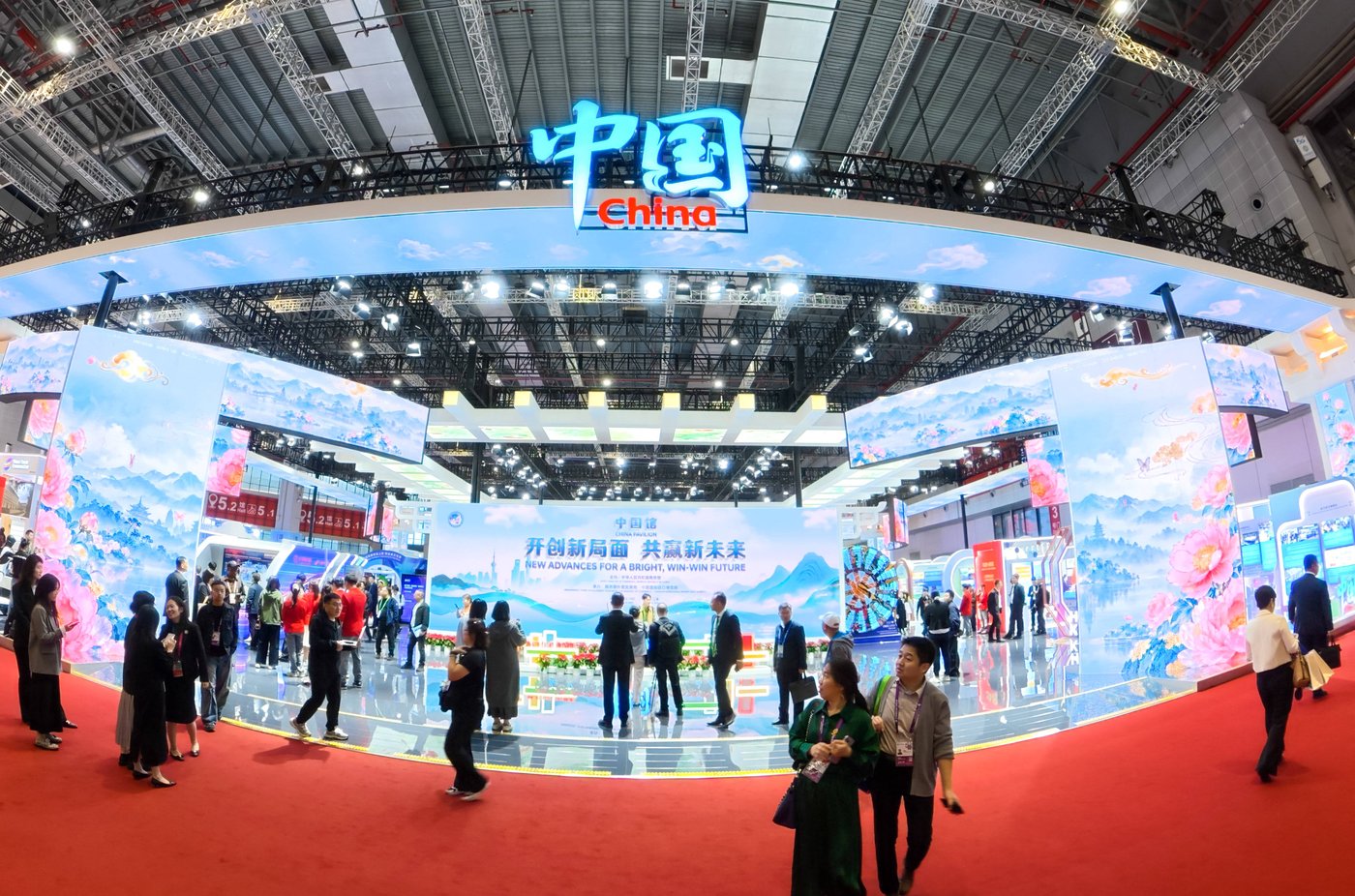
The 9th China International Import Expo closed in Shanghai on 10 November after a six-day run.
Questionnaires and satisfaction scores are unreliable ways to judge an exhibition. One indicator does not lie: how much floor space an exhibitor asks for the following year.
At this edition, several long-standing exhibitors gave a fairly direct answer.
US essential oils company dōTERRA first came in 2018 with a 9-square-metre booth. Those nine square metres brought in orders worth 380 million yuan that year. It has returned every year since, expanding to 300 square metres this time, with its display widening from essential oils to aromatherapy and healthier living. Nine editions, never absent.
Owen Messick, president of dōTERRA China, said the expo gives small and medium-sized companies like his a platform to be seen and understood.
Honeywell's curve is steeper. Its first booth was just over 50 square metres; this year it occupies 500, nearly ten times the size. It appeared under a new brand focused entirely on automation, brought seven debut products and linked more than 200 ecosystem partners. Over the previous eight editions it signed more than 170 strategic cooperation memoranda, and during this show it announced the establishment of an artificial intelligence research institute.
Yu Feng, president of Honeywell Technology Greater China, put it this way: the CIIE is neither a starting point nor an endpoint — it is a process in itself.
Why booth space grows has little to do with orders alone. A company in its first year brings mature products and tests the water. In its second year it brings debuts and looks for channels. By the third year it is still coming usually because some part of R&D, production or supply chain has already landed here.
Elekta is a case in point. During this edition the radiotherapy equipment maker marked the roll-off of the 1,000th high-energy medical linear accelerator from its Beijing plant. From an initial "mirror factory" following global standards to integrated local R&D, manufacturing and supply chain, it achieved full domestic production across its product line in 2025, turning the Beijing base into the most complete production hub in its global network. High-end radiotherapy equipment made in China now exports to more than 130 countries and regions.
Gong Anming, global executive vice president and president of Elekta China, summed it up as "in China, for China, for the world".
Investment commitments weigh more than booth space. In February this year, Zeiss broke ground on a Greater China headquarters campus in Shanghai — the German optics and optoelectronics company's largest single infrastructure investment in China to date. Maximilian Foerst, president and CEO of Zeiss Greater China, said China is both the company's largest market and an important source of innovation.
There is also the reverse path. Dutch coatings company AkzoNobel is exhibiting for the first time, but its ties with China go back much further — the coating schemes for the C919 narrowbody airliner and the "Adora Magic City" cruise ship both came from the company. Simon Parker, global business director for marine, protective and industrial coatings, described the shift in identity as moving from "witness" to "participant".
Orders carry weight too. On 6 November, COFCO Group held a global agricultural cooperation initiative launch and signing ceremony at the venue, with total agreements exceeding 10 billion US dollars. COFCO Oils signed bulk agricultural purchase agreements with ADM, Cargill, Bunge and Louis Dreyfus for a ninth consecutive year, and COFCO Sugar reached its ninth straight raw sugar cooperation with Brazilian partners. Chairman Li Guoqiang said the aim is to turn the expo's open momentum into practical cooperation.
Most telling is early renewal. Before this edition even closed, Zeiss, Elekta and others had already signed up for the 10th CIIE.
The macro numbers follow the same curve. The first CIIE drew 3,617 overseas companies across 300,000 square metres; this edition has 4,142 overseas companies and overall exhibition space above 440,000 square metres for the first time. The first eight editions together exceeded 580 billion US dollars in intended deals.
But for the people who run exhibitions, the macro figure matters less than one concrete act: whether a company is willing to commit next year's budget to the same venue, in advance.
Booth space, renewal timing, investment landing — those three together form an exhibition's real report card. None of them sits in a prominent place in the press release, yet each is harder evidence than any appraisal.