
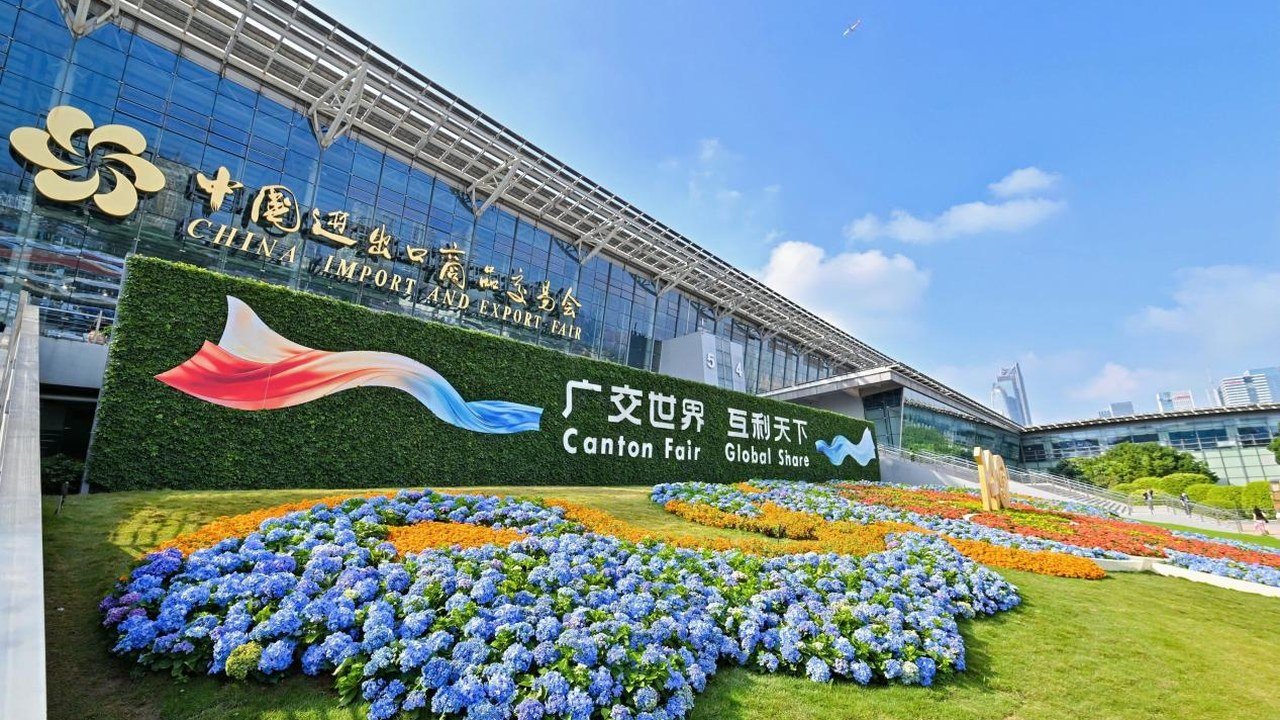
The 140th China Import and Export Fair closed in Guangzhou on 4 November, coinciding with the 70th anniversary of its founding.
The fair ran in three phases from 15 October to 4 November, focused in turn on advanced manufacturing, quality home goods, and a better life.
Looked at through buyers, exhibits and exhibition operations, what is worth recording from this edition goes well beyond scale.
Buyers: 352,000 from abroad and a new buyers' alliance
Professional buyers are the lifeblood of any exhibition, and overseas professional buyers are the market moat of China's best-known trade shows.
This edition drew 352,000 overseas buyers from 219 countries and regions, up 12.2 per cent on the previous session and a record high.
Alongside the headcount, one institutional change deserves note: the Canton Fair Buyers' Alliance was formally established. Aimed at leading global buyers — Fortune 500 companies, the world's top 250 retailers and major buyers from key markets — it moves the fair's service model from simple reception and support towards multi-party coordination and shared value creation. Fifty-eight companies from 32 countries and regions have confirmed membership.
The alliance is designed as a standing communication platform for members to share information and resources, and to upgrade cooperation from trading partnerships to industrial and supply chain partnerships. Benefits include one-to-one matchmaking, priority access to specialised trade events, complimentary use of negotiation space and early access to new product information. The fair plans to build on the platform with further supply-demand matching and industry exchange activities.
Petar Brazin, a buyer from Germany, said he was very glad to trade with China because it opens up new development opportunities — new factories, new suppliers, new manufacturing partners and access to all kinds of resources.
The alliance serves leading buyers, most of them from overseas. The 19-year Canton Fair "marathon" of one Colombian businessman shows where that loyalty comes from.
Camilo first walked into the exhibition halls in 2008 and covered every zone — furniture, machinery, building materials, textiles, without skipping one. After the fair closed he set out from Guangzhou through Fujian, Zhejiang and Shanghai, visiting more than a dozen Chinese factories. More than a decade on, many of those factories remain his main business partners and close friends.
His company, Basal Trading, has grown from a small operation into a mature business with branches in Guangzhou, Hong Kong and Fujian. In 2017 he became a council member of the China-Colombia Chamber of Investment and Trade.
In his view, the fair has changed and innovated while remaining constant in one respect: mutual benefit and good faith. Camilo said every trade link on this platform carries warmth and efficiency. That face-to-face connection gives cooperation more confidence and friendship more weight.
Exhibits: structural change inside 4.88 million products
The exhibition covered 1.55 million square metres with more than 75,000 booths and 32,000 exhibitors, including over 11,000 quality companies such as specialised and innovative small and medium enterprises and single-category champions.
Among nearly 4.88 million exhibits, new products accounted for 23.2 per cent and green products 26 per cent, both record highs, while 64 per cent of exhibitors applied technologies such as the industrial internet and artificial intelligence.
From exporting products made in China to exporting the production lines that make Chinese products, the boundaries of what the Canton Fair displays have widened.
Overseas buyers at the booths are increasingly discussing customised solutions, long-term maintenance and value-added services beyond the product itself. Many exporters have moved past the traditional model of selling a single item towards offering complete production lines and one-stop delivery, or expanding abroad through "product plus supporting services" and "product plus customised solutions".
The first phase centred on advanced manufacturing, showcasing large CNC machine tools, industrial automation and other frontier achievements, with a group of domestic high-end equipment on display. Many links once dependent on imports have achieved domestic breakthroughs. Drawing on accumulated technology and overseas service networks, companies have extended from full-chain production capacity for entire lines to customised line solutions for metalworking.
A newly established debut zone concentrates launches scattered across individual booths into a single entry point for release, display and matchmaking. More than 700 debut events were held during the fair.
A first-time US buyer, trying an ECG monitoring product in the experience area, said: "There are so many new products — I can't wait to take some home."
For buyers, finding new products among 75,000 booths used to be a matter of luck; now there is a starting point to work from.
The trade services zone achieved full coverage of ten categories of producer services for the first time. Some 36.5 per cent of exhibitors are advancing a "product plus services" transformation, nearly 20 per cent have begun outbound investment, and together they have created more than 200,000 local jobs.
An upward shift in the fair's product mix demands a matching shift in services. An exoskeleton robot can close a deal through a live demonstration, but selling, servicing and iterating it across more than 50 countries requires certification, logistics, finance, compliance and an overseas service network.
The substance of this edition's "firsts" is not busier trading but assembling the capabilities that trading depends on.
Digital operations: 22 scenarios and one navigation map
The fair introduced 22 smart application scenarios and 16 artificial intelligence applications, achieving booth-level navigation across the venue.
A digital Canton Fair is not merely a system but a convergence of roles and dimensions — organiser, venue operator, service providers and city support services. The upgraded Canton Fair app offers 26 service functions covering the full cycle, so that buyers can hand routine matters to the system and keep their energy for negotiation.
Navigation is another detail rebuilt by technology. The fair adopted integrated positioning combining Bluetooth, BeiDou and 5G for the first time, covering 45 exhibition halls, 1.55 million square metres and more than 75,000 booths, with accuracy of one metre. In a space almost impossible to walk end to end, "finding" itself has become infrastructure, so that both sides spend more time doing business and less time looking for stands.
One phone now runs the entire journey: before the fair, buyers can search exhibitors and products, book meetings and plan their schedule through the app; during the fair, AI notes turn photographed products and recorded conversations into automatic summaries; afterwards, the system archives everything and screens high-intent customers.
The contractor system was also rebuilt. The fair overhauled its system for fit-out contractors, presenting full profiles covering design capability, partner factories, awards and service ratings. A new "fit-out services" section in the Canton Fair Services mini-programme adds a showcase for modular construction, helping exhibitors compare and connect more easily. AI booth design was introduced for the first time, supporting intelligent matching, visual previews and one-click drawings.
Building on the dashboard introduced at the 139th session, this edition upgraded to a smart command centre for the venue — its brain and nerve centre. It integrates monitoring, alerts, forecasting, advisory and dispatch across eight scenarios, with 56 alert types in six categories connected to 40 internal and external systems. Crowd heat maps, smart traffic and move-out management, security and emergency response, and smart electrical cabinet control all run through it.
The fair also worked with the Haizhu district government of Guangzhou on the Canton Fair Pazhou AI Model brand, offering 16 AI service scenarios across four categories: smart services, technology performances, product experiences and smart security. Seven mature scenarios such as drone delivery, robot guides and robot dog patrols were further refined, while nine new ones made their debut, including AI traditional Chinese medicine consultations, a robot band, AI glasses and an emotion-sensing smart ring.
Venue electricity came entirely from green power — wind, solar and other renewables purchased through the national green certificate trading system. With blockchain support on the power trading platform, each kilowatt-hour is traceable: when a light comes on in the hall, you can trace it to a specific wind farm or solar plant.
The 2026 Canton Fair Design Innovation Award was announced at the same time, with 222 products from 174 companies honoured. Smart products accounted for 32 per cent of winners and green products 44 per cent, spanning AI glasses, smart health devices, photovoltaic energy-saving components and bio-based materials across home, office and outdoor applications. A dedicated display area showed nearly 300 products, building a trade promotion model that runs from showcasing results to supply-demand matching.
At 70, the Canton Fair remains a trading floor. But it is slowly learning that the best moment to close a deal sometimes comes before the contract is signed, sometimes in the few minutes a buyer spends trying on an exoskeleton, sometimes in a conversation where a service provider helps a small company work out the real cost of going global. When so many of those moments are built systematically, a transaction becomes more than a one-off encounter.