
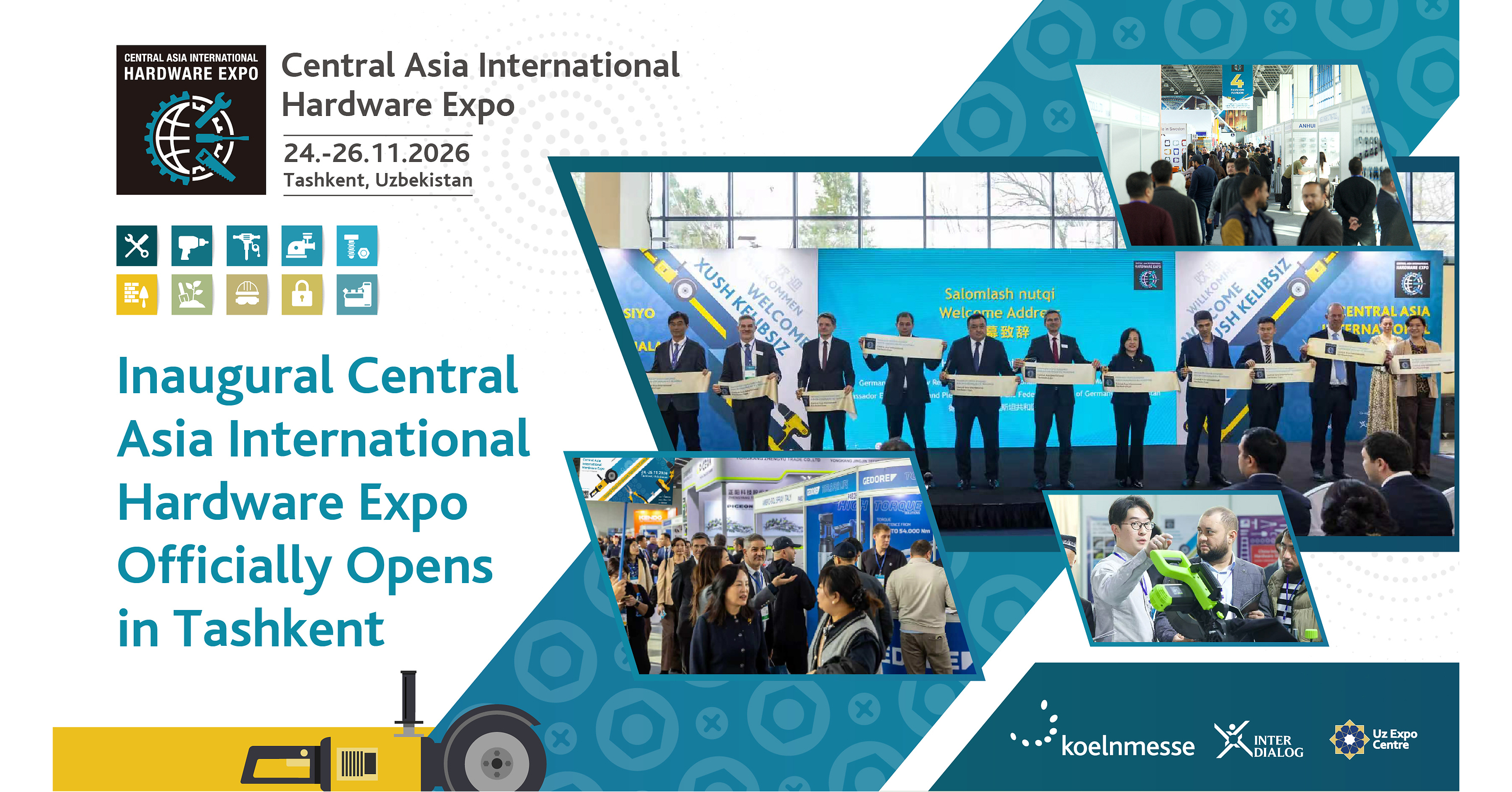
As the global hardware supply chain rapidly extends its reach into the Eurasian heartland, a premier trade event dedicated to B2B professional sourcing has established its first regional foothold at Uzexpocentre in Tashkent, where the Central Asia International Hardware Expo (CAIHE 2026) officially opened on November 24, 2026.
Why has Central Asia emerged as a highly sought-after new frontier for international hardware giants? The answer lies in the dual engines driving the region: robust infrastructure investment and rapid industrialization.
Viewed through the macro lens of global supply chain realignment, Central Asia serves not only as the geographical crossroads of Eurasia but also as a critical strategic niche for the global relocation of the hardware industry and capacity cooperation. Currently, as the global hardware sector grapples with sluggish growth in traditional markets, Central Asia is generating massive demand for equipment upgrades and foundational materials, fueled by sustained infrastructure investment and industrial modernization. This market expansion, driven by endogenous industrialization, has propelled the region from a peripheral market to a core growth pole. As the economic and demographic hub of the region, Uzbekistan has naturally emerged as the premier gateway for international capital and advanced manufacturing capacity entering the Central Asian heartland, offering multinational hardware enterprises highly strategic incremental growth opportunities.
Driven by these industry dynamics, and empowered by the decades of global expertise from Germany’s EISENWARENMESSE combined with the extensive international network of Koelnmesse, the inaugural CAIHE successfully brought together 165 exhibitors from 10 countries in Uzbekistan, facilitating precise matchmaking between global suppliers and regional professional buyers.
The successful launch of a regional professional trade show invariably relies on deep synergy among government, industry, academia, and research institutions. Behind this landmark event in Tashkent stands an extensive transnational support matrix. Beyond the domestic policy backing provided by the Ministry of Investments, Industry and Trade of Uzbekistan and the Chamber of Commerce and Industry of Uzbekistan, the joint endorsement by the German and Chinese embassies in Uzbekistan underscores the exhibition's role in fostering international bilateral trade. Furthermore, the deep involvement of Chinese institutions—including the China Chamber of Commerce for Import and Export of Electromechanical Products, the Foreign Trade Division of the Shandong Provincial Department of Commerce, and the Zhenjiang Sub-Council of the China Council for the Promotion of International Trade—has further solidified the foundation for aligning the hardware supply chains between China and Uzbekistan, as well as China and Europe. On the industry collaboration front, the broad engagement of organizations such as the Uzbekistan Association of Electrical Engineering and Cable Manufacturing, the management of Uzexpocentre NEC JSS, and the Italian-Uzbek and French-Uzbek bilateral chambers of commerce has established a comprehensive, multi-tiered exhibition network spanning from official to grassroots levels.
What does this strategic move into Uzbekistan signify for Koelnmesse? Michiel Kruse, Managing Director of Koelnmesse, defines it as a pivotal milestone in the expansion of the company's global footprint. Looking beyond the immediate metrics of a single trade show, he emphasizes from the perspective of the broader industry ecosystem that, buoyed by the dual dividends of infrastructure and industrial development, Central Asia has ascended to a strategic priority market within the global hardware sector. He identifies face-to-face engagement as the cornerstone for building business trust and breaking through market barriers, with Uzbekistan serving as the "master key" to unlocking the doors of Central Asia.