
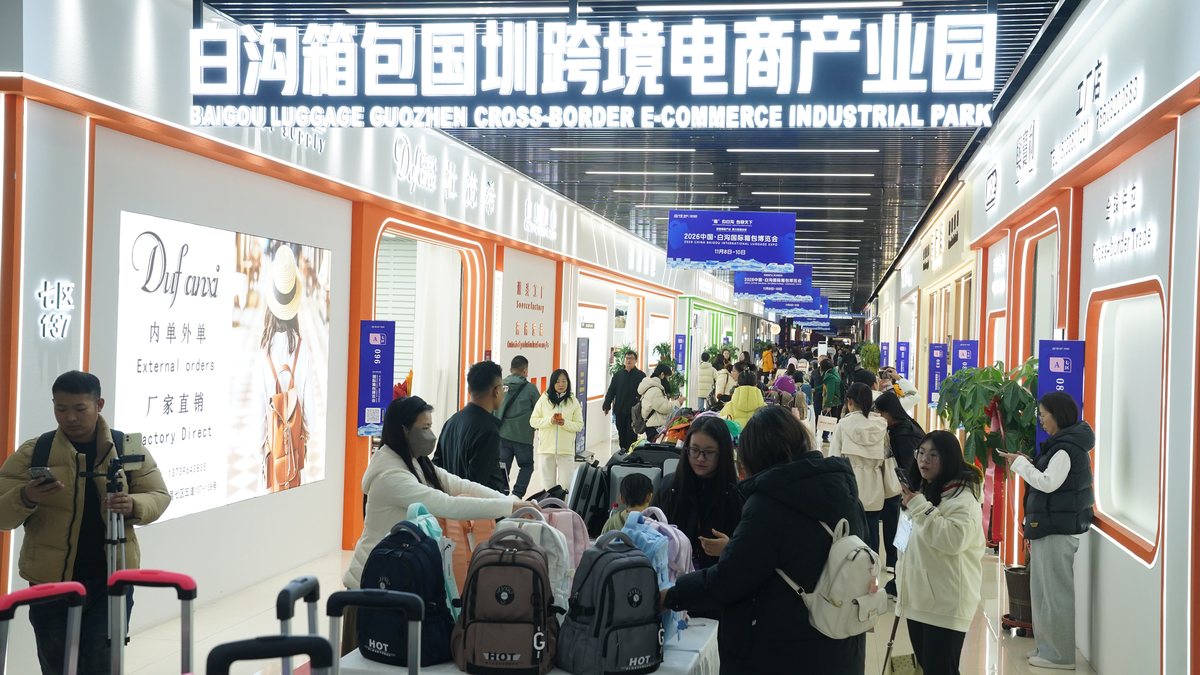
The 2026 China Baigou International Luggage and Bags Expo opened on 8 November at the Heda International Luggage and Bags Trading Centre in Baigou, Baoding, Hebei province. The show runs three days.
Under the theme "Baigou, a Bag for the World — Digital Intelligence Empowering Industry, Pooling Strength to Move Goods Globally", the expo has drawn more than 3,500 buyers from China and overseas.
The buyer mix is worth looking at first. More than 500 international buyers come from the United States, Brazil, Russia, Kazakhstan, India, the UAE, Saudi Arabia, Mongolia and other countries and regions, while over 3,000 domestic buyers come from Henan, Shandong, Zhejiang, Guangdong, Fujian and other hubs of bag manufacturing and distribution.
For an industry-belt expo, that combination is deliberate: international buyers are looking at export channels and price bands, domestic buyers at capacity and how fast styles turn over, and both groups need to meet the same set of factories inside one hall.
The floor is organised into ten themed zones with 253 standard booths, about 50,000 square metres of planned booth space and more than 500,000 square metres of linked exhibition space. Nearly 500 brands are showing, alongside more than 10,000 new bag designs, guochao cultural products, plush goods and intelligent design output.
The layout does not slice the offer by product category. It follows the chain — from creative design and precision manufacturing through accessories supply to domestic distribution and cross-border export. Every link has a place on the floor.
The base of that chain sits in Baigou. The town has worked in bags for more than 50 years and now hosts over 8,000 manufacturers producing close to one billion bags a year, with trade networks covering 205 countries and regions.
Chen Chao, director of the Baigou New Town Industrial Innovation Development Centre, said the town has built a full industrial ecosystem spanning R&D and design, raw and auxiliary materials, production and processing, inspection and rights protection, logistics and trade, and cross-border e-commerce. This edition, he said, uses digital innovation to keep opening up market procurement, cross-border e-commerce and sea-rail intermodal channels.
Three industry-enabling projects were presented at the opening, all aimed at the same thing: getting out to overseas markets.
The China Baigou AI Innovation Centre addresses design, opening AI-assisted design capacity to local firms and shortening the cycle from idea to sample. The Taitong International Multimodal Transport project addresses logistics, plugging sea-rail intermodal services into the industrial belt so the leg from factory to port becomes more controllable. The TradeOS Cross-border Trade Ecosystem Platform addresses transactions, moving cross-border procedures, documents and settlement into one system.
Design, logistics and transactions — precisely the three points where an industrial belt is most likely to stall when it goes abroad.
Yangqi Luggage Manufacturing brought AI-assisted designs to the show this year, using the local supply chain for rapid sampling and serving both online retail and export orders. Its head Wang Ze said the expo brings buyers, platforms and research resources together, letting the company reach customers at home and abroad directly while using the AI centre to refine designs and cut costs.
Four groups of key projects were also signed at the opening, covering state-owned enterprise foreign trade cooperation, industrial park operation, university-industry-research collaboration, and cross-regional chambers of commerce jointly building an export ecosystem.
The supporting programme follows a "one plus twelve" structure. Beyond the main exhibition, twelve parallel events run alongside: a sharing session on brand-led high-quality development of the bag industry, the "Bobo Cup" original design competition awards, a Duoxiu embroidery fashion show, a university-enterprise dialogue on innovation, a training session on AI agents for e-commerce, a cross-border export matchmaking meeting, an international and domestic buyer matchmaking meeting, an AI original design innovation meeting, and a full-chain supply-demand matchmaking meeting.
Of those twelve, only one is purely transactional. The rest are training, matchmaking, launches and competitions. That ratio says something about how industry-belt expos are changing: they are no longer only gathering orders, they are trying to leave capability behind.
For a place like Baigou, the hard part of running an expo has never been selling booths. It is making sure a buyer who arrives can see design, sampling, production, testing, logistics and customs clearance in one pass. The more complete the chain, the higher the cost of switching suppliers — and the more likely the buyer comes back.
The expo runs through 10 November.