
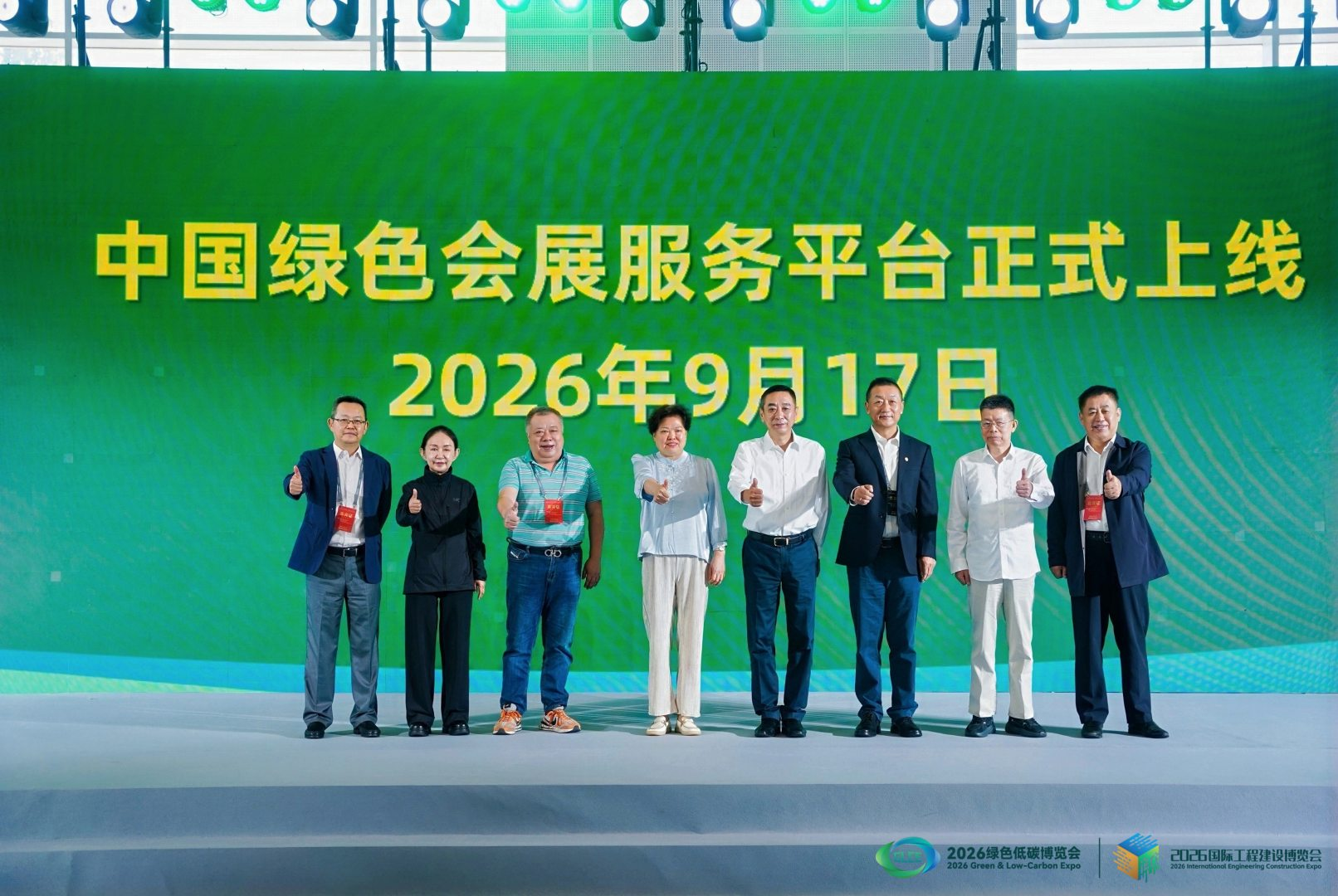
On September 17, the inaugural China Green Exhibition & Convention Conference (CGECC2026) was held at the National Exhibition and Convention Center (Tianjin). Co-hosted by the International Exhibition Economy Committee (ICEEC) of the China Association for International Economic Cooperation, the Exhibition Working Committee of the National Federation of Urban Industrial Product Trading Centers, the Global Expo media platform and the China Green Exhibition Service Platform, the event was a key parallel program of the 2026 Green & Low-Carbon Expo. It gathered hundreds of guests from government authorities, industry associations, exhibition organizers, venue operators and supply-chain service providers to discuss the current state, challenges and future pathways of green exhibitions in China.
Gao Yuanyuan, President of the China Association for International Economic Cooperation; Gao Zijian, Vice President of the National Exhibition and Convention Center (Tianjin) Co., Ltd.; and Liu Xinguo, Deputy Director of the Tianjin Municipal Commerce Bureau and the Tianjin Exhibition Work Bureau, delivered speeches. Lu Cheng, Deputy Director and Secretary-General of ICEEC, moderated the event.
In her address, Gao Yuanyuan stressed that green exhibitions are no minor matter for a single industry, but a concrete action to implement Xi Jinping Thought on Ecological Civilization, serve the national "dual carbon" strategy and advance a green Belt and Road. She called green development the passport for Chinese exhibitions to go global and the greatest common denominator of the global exhibition industry, calling for ecosystem-wide collaboration across the entire industrial chain.
To address the widespread challenge of "wanting to go green but not knowing how," the China Green Exhibition Service Platform, jointly developed by ICEEC and multiple industry institutions, was officially launched. Positioned as a comprehensive public-interest platform integrating standards inquiry, tool support, resource matching and case sharing, it connects government, associations, organizers, service providers and exhibitors with digital support for green-exhibition practices nationwide.
A highlight of the event was the release of the China Green Exhibition Development Report (2026), compiled by ICEEC and framed as "systematic assessment, trend judgment and practical guidance." For the first time examining the industry through a "momentum-driven" lens, the report's chief editor Ying Lijun, Vice Chair of ICEEC and Deputy Director of the Academic Committee of the China Convention and Exhibition Economy Research Association, explained its core ideas and ten insights, arguing that green exhibitions represent a profound reconstruction of the industry's value system, operating models and ecosystem rather than a simple adjustment in how events are run.
In the keynote sessions, Chen Yongqing, former Director-General of the Department of Soil Ecology at the Ministry of Ecology and Environment, reviewed national and local policies, technical guidelines and implementation of carbon neutrality for major events, outlining a path of "deep source emission reduction, standards leadership and market empowerment" for the 15th Five-Year Plan period. Yu Hua, Deputy Director of the Institute of Trade in Services at the Chinese Academy of International Trade and Economic Cooperation, identified five new trends including normalized policy support, full-lifecycle management and the synergy of digitalization with greening, while acknowledging cost pressures and uneven standards adoption among small and medium-sized exhibitions. Deng Shuai, Vice President of Jingzheng Exhibition Group, shared the organizer's practices in digital catalogues and green booth ecosystems, asserting that "green is competitiveness."
A panel moderated by Fan Peikang, Chairman of ICEEC and former President of China Trade News, brought together Zhao Chuang, Zhang Lijuan, Wu Furong and Deng Shuai to debate the cost-effectiveness and implementation pathways of green exhibitions. Participants agreed that while green transformation adds costs in the short term, it is essential to long-term competitiveness and requires policy guidance, whole-chain collaboration and digital empowerment.
The two-and-a-half-day conference also included sessions on green display, industry-education integration, green-exhibition standards and digital empowerment. Together with the launch of the service platform, the release of the 2026 report and the rollout of relevant national standards, the event marks a new stage of coordinated standards-based, green and digital development for China's exhibition industry.